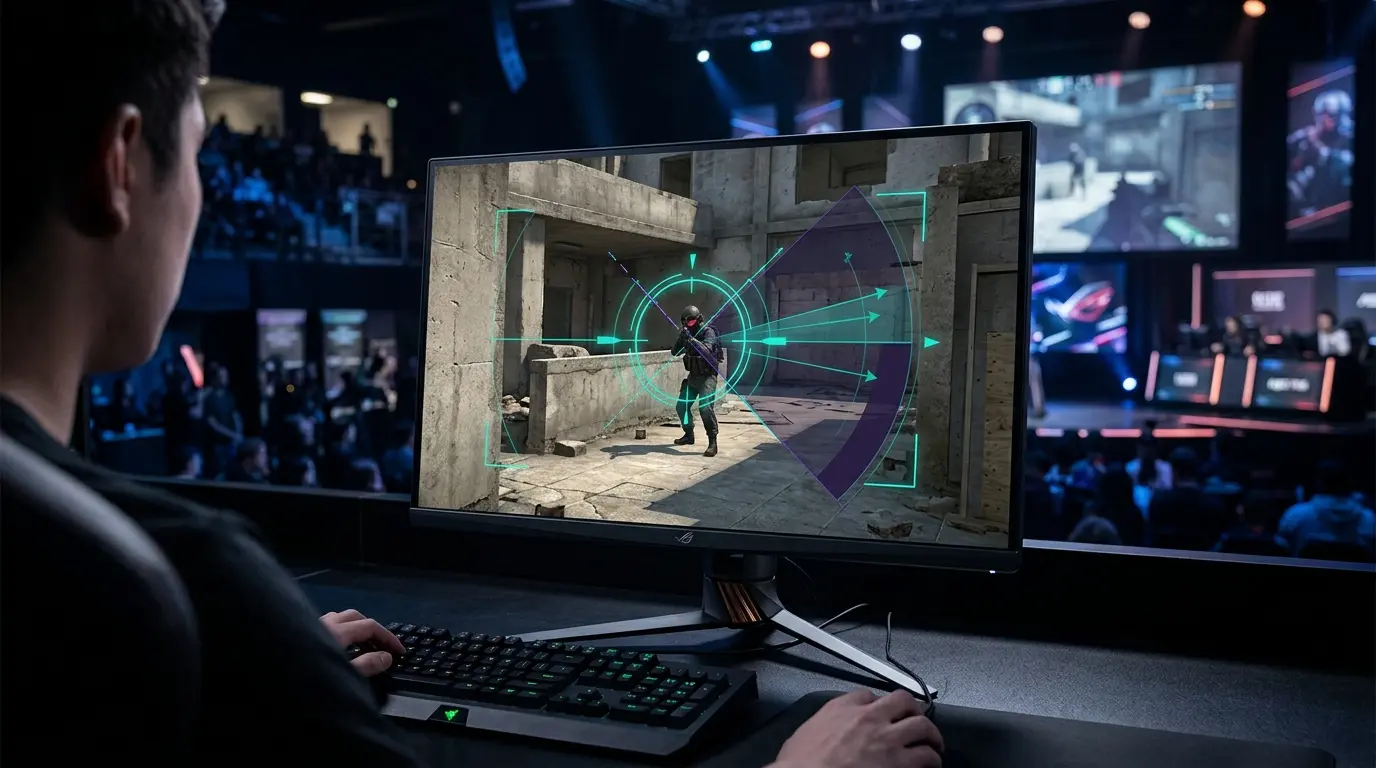
You plug in your controller, load into a ranked match, and within thirty seconds you’re dead from a shot that should have been physically impossible. In 2026, the opponent on the other end may not be a human with fast reflexes — they may be running an AI-powered cheating system that reads your position through computer vision and corrects their aim faster than any human can react. This guide explains the seven categories of AI cheats flooding online games, how the external hardware loop defeats kernel-level anti-cheat entirely, and what both developers and players can actually do about it.
What AI Cheating in Online Games Actually Means in 2026
AI cheating in online games 2026 represents a structural shift, not just a new flavor of the same old problem. The defining change is the move from software-level memory manipulation to external hardware loops that leave zero footprint on the host machine. That means the entire premise of kernel-level anti-cheat — monitoring the operating system for unauthorized code — becomes irrelevant against the most advanced tools.
Two factors drive this shift. First, generative AI coding tools have lowered the barrier to building functional cheat software to near-zero, so non-programmers now enter the cheat marketplace. Second, the competitive online gaming economy has grown large enough that cheating is no longer a fringe nuisance but a systemic integrity problem affecting developer revenue and player retention. The result is a two-front war: traditional software cheats (still in wide circulation) operating alongside the new AI and computer-vision paradigm.
A Brief History: From Game Genie to Generative AI
Cheating in games is not new. The Game Genie era was locally contained, single-player, and non-competitive — there was no adversarial incentive to cheat because no one else was affected. The shift to online multiplayer created the first real incentive structure: rank, reputation, and in some cases money.
Traditional aimbots and wallhacks worked by injecting code to read RAM coordinates of opposing players. That software footprint was exactly what kernel-level anti-cheat was designed to catch. For years, the arms race followed a predictable pattern: cheat developers found a memory offset, anti-cheat teams patched it, and the cycle repeated.
The inflection point arrived between 2023 and 2026. Generative AI coding acceleration let cheat developers use large language models to generate and obfuscate cheat code faster than anti-cheat teams could patch. Combined with the emergence of external hardware loops, the old rules of engagement no longer apply.
The Seven Categories of AI Cheats: A Technical Taxonomy
Modern AI cheats fall into seven distinct categories, each with a different technical mechanism and a different blind spot for anti-cheat systems. Understanding the full taxonomy is essential for anyone building or evaluating anti-cheat strategies in 2026.
- Pixel-Based AI Bots: These read screen pixels rather than game memory. Open-source projects like AIMr implement AI-driven aimbots in Python that work on any game with human-shaped models, using OpenCV and deep learning. They avoid memory scanning entirely but are detectable through behavioural analysis of input patterns.
- Memory-Reading Aimbots and Wallhacks: The legacy approach — inject code to read RAM coordinates of opposing players. Kernel-level anti-cheat has made these less viable, but they persist in games where anti-cheat support is weaker.
- Computer Vision Bots Using YOLO Object Detection: YOLO (You Only Look Once) models identify enemy player models in video frames at inference speeds fast enough to drive sub-100ms aim corrections. ConsoleCheat’s AI aimbot allows switching between YOLOv5, YOLOv8, YOLOv10, YOLOv11, YOLOv12, and custom ONNX models.
- External Hardware Loop Cheats: Screen output is cloned to a capture card, processed by an external device running computer vision inference, and the result is injected via an HID emulator like Titan Two. No software touches the host machine.
- Macro and Input Automation: Scripted sequences of inputs execute faster and more consistently than human hands. These are effective in rhythm games, MMOs, and trading card games where precise timing matters more than aiming.
- Game-State Exploitation and Speed Hacks: These manipulate server-reported game-state variables. Server-side validation catches them, but memory scanners cannot.
- AI-Assisted Scripting and Combo Automation: Generative AI tools write optimized macro scripts for fighting games and MOBAs, lowering the skill floor for complex mechanical execution.
AI cheats in categories 3 and 4 represent the most technically novel threats, because they operate entirely outside the software environment that anti-cheat systems are designed to monitor.
The External Hardware Loop: Why Kernel-Level Anti-Cheat Cannot See It
The external hardware loop is the single most important cheat mechanism to understand in 2026, because it defeats the entire premise of kernel-level anti-cheat. Here is exactly how it works, step by step.
- Clone the signal: An HDMI splitter clones the gaming PC or console’s video output without interrupting the primary display feed. The console sends 1080p video to both the TV and the capture card simultaneously.
- Capture the clone: The cloned feed enters an external capture card (Elgato or AVerMedia) connected to a second device — typically a separate PC running the cheat software.
- Run CV inference: The second device runs a YOLO-based computer vision model that processes incoming frames in real time, identifying enemy player models. On a mid-range GPU, YOLOv8 processes each frame in approximately 10–15 milliseconds.
- Calculate corrections: The model calculates aim corrections (delta-X and delta-Y) based on detected enemy positions. The total latency from frame capture to calculated correction stays under 30 milliseconds.
- Inject via HID: Corrections are sent to a Titan Two or similar HID emulator that sits between the controller and the console. The device translates aim commands into standard controller input signals over USB. The game’s anti-cheat sees only a legitimate peripheral.
Kernel-level anti-cheat operates entirely within the host machine’s operating system. It has no architectural visibility into external hardware or a second device’s processes. ConsoleCheat explicitly advertises its AI aimbot as using HDMI video capture and USB controller input via Titan Two, stating that no software, no memory modifications, and no file changes are made on the host — and that no anti-cheat can detect external hardware.
Detection requires moving outside the kernel entirely: behavioural biometrics, network-side anomaly detection, or hardware attestation. None of these are universally deployed in 2026.
Cheating as a Service: How GenAI Democratised the Cheat Marketplace
Cheating as a Service (CaaS) has reduced the barrier to entry to near-zero. Casual cheaters access ready-made tools via Discord servers and TikTok tutorials without any programming knowledge. A few clicks and a subscription payment are all it takes to run an AI-powered cheat in a competitive match.
Private cheats represent the premium tier of this market. Subscribers pay a monthly fee for bespoke cheat software that auto-updates within hours of a new anti-cheat patch. ForgeCheats and CamelotCheats both maintain catalogs of PUBG Mobile cheats labeled as “Undetected,” “On Update,” or “Risky,” indicating the ongoing arms race between cheat authors and mobile anti-cheat systems like Tencent ACE.
Generative AI coding tools have accelerated cheat development cycles significantly. Cheat authors can now generate obfuscated, functional cheat code faster than anti-cheat engineering teams can reverse-engineer and patch it. The economic asymmetry is stark: a private cheat subscription costs tens of dollars per month, while the anti-cheat engineering response costs orders of magnitude more in developer hours.
Discord servers and TikTok function as both discovery channels and storefronts. Cheat vendors post demonstration clips, handle customer support, and distribute download links through platforms with limited moderation. For mobile games like PUBG Mobile and BGMI, cheat marketplaces list multiple private cheats with bundled features including aimbot, ESP, radar, “Magic Bullet,” and “Conqueror” rank boosting, all sold as subscription services.
The Asymmetry Problem: Why Building AI Anti-Cheat Is Harder Than Building AI Cheats
Peer-reviewed research published in Applied and Computational Engineering (2024) found that building an AI anti-cheat system requires greater computational resources and engineering complexity than building the AI cheat it targets. This asymmetry is structural and explains why most game studios still rely on traditional anti-cheat systems despite AI cheats being the dominant emerging threat.
A functional YOLO-based cheat system can be prototyped in Python by a single developer. The same developer can train a YOLOv8 model on publicly available frames and have a working computer vision aimbot within days. A behavioural anti-cheat system, by contrast, requires large labeled datasets and continuous model retraining at scale. One public dataset for cheat detection contains 3,584 normalized instances using 2-second time windows, with engineered features like angle_error_mean, angle_error_max, isAimbot_max, and accuracy_rate — but assembling and labeling such a dataset is itself a significant engineering effort.
Academic frameworks like HAWK (2024) demonstrate the potential of AI-driven anti-cheat, reaching up to 84% recall and 80% accuracy for aimbots and wallhacks using LSTMs and ensemble models on replay data. VESPA, a vision-based system for ESP cheats, integrates YOLO object detection with human review. But these systems remain research prototypes, not production-ready solutions. The asymmetry means that a multi-layered anti-cheat stack combining kernel-level detection, behavioural biometrics, and server-side validation is more realistic than any single AI anti-cheat solution.
Are AI Cheats Detectable? Current Anti-Cheat Approaches and Their Limits
The answer depends on which cheat category you are talking about. No single detection layer covers all seven categories, and understanding the gaps is the only way to build a realistic assessment.
| Detection Layer | Effective Against | Blind Spot |
|---|---|---|
| Kernel-Level Anti-Cheat | Software-injection cheats (memory reading, DLL injection) | External hardware loops that never touch the host OS |
| Behavioural Biometrics | AI aimbots with inhuman precision or input consistency | Humanized aimbots tuned to mimic natural variance |
| Server-Side Validation | Speed hacks, magic bullets, impossible physics | Aim assistance operating within plausible human parameters |
Activision’s Ricochet combines kernel drivers with server-side machine learning to analyse client and server data, input timing, and recoil patterns. Valve’s VACnet uses a server-side neural network trained on demos. Riot’s Vanguard includes a dedicated behaviour detection bucket built entirely on machine learning suspensions. Riot reports that after ML improvements, the percentage of ranked games with a cheater fell below 1% globally in Valorant, with 3.6 million bans between 2020 and 2024.
Yet the external hardware loop remains the gap that no current system fully closes. Because the cheat software runs on a separate device and the host machine sees only legitimate controller inputs, there is no code signature, no memory modification, and no process to scan. The hardware loop is technically detectable but only through methods that are not yet widely deployed: network-side analysis of input timing patterns or hardware attestation at the platform level.
Legal and Ethical Dimensions: Is AI Cheating Illegal in the US?
Cheating in video games typically violates a game’s Terms of Service, which is a civil matter. The consequences for end users are account bans rather than criminal prosecution. The legal landscape changes when cheat software is sold commercially, because the Computer Fraud and Abuse Act (CFAA) has been used to pursue legal action against cheat software developers and distributors.
Activision secured a $14.465 million judgment against EngineOwning for Call of Duty cheats, finding violations of the DMCA, CFAA, and RICO. The court calculated damages for DMCA anti-circumvention as $200 per cheat download, multiplied by 72,328 US downloads. Bungie obtained $16.17 million in damages against Destiny 2 cheat developer Wallhax, with CFAA violations explicitly recognized. The court in Bungie v. Larsen held that intentionally accessing Destiny 2 servers to obtain software for cheat development violated the CFAA because it breached license terms and manipulated game elements.
The Cheating as a Service model creates clearer legal exposure for cheat operators than for end users. Commercial distribution of circumvention tools is more readily prosecutable under the CFAA than personal use. This is a US-focused treatment; legal frameworks vary by jurisdiction and evolve rapidly alongside the cheat marketplace itself.
The Path Forward: What Developers and Players Can Do in 2026
For developers, the evidence points to one conclusion: a multi-layered anti-cheat stack combining kernel-level detection, behavioural biometric analysis, and server-side physics validation is necessary. No single layer is sufficient. Partnering with specialist anti-cheat technology providers is worth considering given the asymmetric cost of AI anti-cheat development demonstrated by peer-reviewed research.
For players, the single most effective action is to report suspected cheaters with replay evidence. Behavioural data from replays is the input that trains anti-cheat detection models. AI-cheating opponents exhibit inhuman aim consistency across an entire match, not just one clip — this statistical pattern is the distinguishing marker of AI-assisted play. Players on platforms with strong server-side anti-cheat and hardware ban appeal processes are better protected than those on platforms relying solely on kernel-level detection.
Platform-specific variation matters. External hardware loops are primarily a PC threat; console cheating is constrained by hardware attestation, though devices like Cronus Zen and XIM Apex still function by scripting aim assist and recoil control. Mobile and Android cheating leans toward pixel bots and emulator-based automation, with cheat marketplaces for PUBG Mobile and BGMI actively listing new config files as recently as August 2026. Understanding which threats apply to your platform is the first step in defending against them.
For a deeper look at the anti-cheat systems that are fighting back, see our guide on how anti-cheat really works in big 2026 online games.
AI does not independently cheat in online games. The AI is a tool used by a human player to automate aiming, tracking, or decision-making. The technology runs on a separate device or process and feeds input back to the game, but a human must still initiate the match and make high-level strategic decisions.
It depends on the cheat category. Software-based AI cheats can be detected by kernel-level anti-cheat and behavioural analysis. The external hardware loop, which processes video on a separate device and injects controller inputs via an HID emulator, is architecturally invisible to kernel-level detection. No current system fully covers all seven cheat categories.
The external hardware loop clones a console or PC’s HDMI output to a capture card, processes the video on a separate computer using YOLO object detection to identify enemies, and injects aim corrections via a Titan Two or similar HID emulator. Kernel-level anti-cheat cannot detect it because no software or memory modification occurs on the host machine — the game sees only legitimate controller inputs.
CaaS is a subscription-based model where cheat developers sell ready-made cheat software through Discord servers, TikTok, and dedicated marketplaces. Subscribers pay a monthly fee for tools that auto-update within hours of a new anti-cheat patch. The model has lowered the barrier to entry so that non-programmers can access AI-powered cheats with minimal effort.
Valorant, Apex Legends, and Call of Duty are among the most affected titles. Riot reports that less than 1% of ranked Valorant games contain a cheater globally. Apex Legends Season 21 on PC saw 949 cheaters reaching Predator rank versus 750 legitimate Predators. Activision’s legal filings against EngineOwning cited 72,328 US downloads of Call of Duty cheats.
Using cheats typically violates a game’s Terms of Service, which is a civil matter resulting in account bans. The Computer Fraud and Abuse Act has been used against cheat developers and distributors who sell commercial cheat tools. Activision’s $14.465 million judgment against EngineOwning and Bungie’s $16.17 million judgment against Wallhax established that commercial cheat distribution can violate the DMCA, CFAA, and RICO.
Peer-reviewed research in Applied and Computational Engineering (2024) found that AI anti-cheat systems require greater computational resources and engineering complexity than the AI cheats they target. A single developer can prototype a functional YOLO-based cheat in days, while a behavioural anti-cheat system needs large labeled datasets and continuous model retraining at scale.
YOLO (You Only Look Once) models are trained on labeled frames containing enemy player silhouettes. At inference, the model processes each video frame in approximately 10–15 milliseconds on a mid-range GPU, outputting bounding boxes and confidence scores. The cheat software calculates aim corrections from these bounding boxes and sends mouse or controller input to lock onto targets, operating well under the ~200 millisecond human reaction time.
Technical claims in this article are drawn from peer-reviewed research published in Applied and Computational Engineering (2024), industry practitioner guides, developer announcements from Riot Games, Activision, and Valve, and cybersecurity publications. The asymmetry finding is sourced from the ResearchGate DOI: 10.54254/2755-2721/73/20240402. Academic anti-cheat frameworks HAWK and VESPA are documented in arXiv preprints and the IJRASET literature review.
Last updated: September 2026 • Written by the Gameluster Technical Team.