
Sports betting Philippines platforms have moved almost entirely to the smartphone, backing Ginebra in the PBA or fading the Lakers now takes four taps, with deeper markets and better odds than any retail counter.
This guide explains how sports betting in the Philippines is regulated, why only platforms licensed by PAGCOR (the Philippine Amusement and Gaming Corporation) should be used, what to check on PBA and NBA depth, odds margins and deposit routes after the August 2025 e-wallet crackdown, and how to judge whether a welcome bonus is clearable or decorative. We also explain the GCash situation correctly, because most guides get it wrong.
Top Sports Betting Sites in the Philippines






Best Sports Betting Sites Philippines in comparison
The difference that matters is not the size of a bonus. It is who licenses the platform, which body you can complain to when something goes wrong, whether the book prices the PBA at all, and how your money gets in and out under the current BSP payment rules. The comparison below sets out the three routes Filipino bettors come across, and why only one of them is recommended on this page.
| Route | Regulator | Legal status for Filipino residents | Dispute route | Our view |
| PAGCOR-licensed online platforms | PAGCOR | Authorised | Operator, then PAGCOR | Recommended route |
| Licensed retail sportsbooks and betting stations | PAGCOR | Authorised | Operator, then PAGCOR | Regulated alternative |
| Offshore books (Curaçao and similar licences) | None in the Philippines | Not licensed to serve the Philippines | No Philippine recourse | Not recommended |
What to Check Before You Bet: Sports Betting Sites Philippines Bettors Should Use
We do not review or rank individual offshore sportsbooks on this page. Instead, here are the five checks that separate a regulated Philippine betting platform from one that leaves you without protection. Apply them to any site before you register, and the field narrows quickly to PAGCOR licensees.
1. A PAGCOR registration you can verify
The single most important check is whether the platform is licensed by PAGCOR to offer betting to people inside the Philippines. PAGCOR both regulates and operates gambling in the country, and it publishes information about its licensed and accredited operators on its official website. A licence logo in a footer is a claim, not proof. Look up the operator name on PAGCOR‘s own site rather than trusting the badge, and treat a missing or foreign-only licence as a reason to walk away.
This matters because a foreign licence such as Curaçao or Kahnawake does not authorise an operator to serve Filipino residents. If a book of that kind voids your bet or freezes a withdrawal, PAGCOR cannot step in, and you are left with the operator’s own complaints process and a regulator on the other side of the world.
2. Age and identity checks done properly
The legal gambling age in the Philippines is 21. A regulated platform will ask for proof of age and identity before you can withdraw, and usually before you can deposit. That is a feature, not friction: identity checks are how a licensed operator meets anti-money-laundering rules and keeps minors out. A site that lets you bet without any verification, or that shows only an 18+ notice, is telling you it is not working under Philippine rules.
3. Genuine PBA and NBA depth
Basketball is the market Filipino bettors actually use, so check the basketball menu during a live game window. A useful book prices the Philippine Basketball Association beyond a token moneyline, with handicaps, totals and quarter lines, alongside full NBA coverage. Football should include Asian handicap, both-teams-to-score and correct score on the Premier League and Champions League, and combat sports pricing should go past the winner market into method of victory and round groups for the major title fights.
4. Payment routes that comply with BSP rules
Since BSP Memorandum M-2025-029, e-wallets supervised by the Bangko Sentral ng Pilipinas have removed in-app gambling access. A licensed platform will tell you which local rails it supports today, such as direct bank transfer or on-site e-wallet payment, and will publish its withdrawal times and limits. Be wary of any site that pushes you towards crypto or third-party agents as the main way to fund an account: that is a typical sign of an offshore book working around Philippine payment controls.
5. Bonus terms you can actually read
Headline bonus numbers mean little without the rollover. Divide the bonus by the wagering requirement, check the minimum odds and which markets count, and look for time limits. Regulated operators have to publish clear terms. Offshore books often advertise very large percentage matches with steep or undisclosed playthrough, which is one more reason they are not recommended here.
Offshore sportsbooks licensed in Curaçao or elsewhere remain visible to Filipino bettors through search and social media, but they are not licensed by PAGCOR, are illegal to operate towards the Philippine market and are not recommended on this page. The regulated alternative is a PAGCOR-licensed platform or a licensed retail sportsbook.
How to Verify a Sports Betting Site Step by Step
- Find the operator’s legal name. Look in the site’s terms and conditions or footer for the company that runs it, not just the brand name on the homepage.
- Check it against PAGCOR. Search for that company and brand on PAGCOR‘s official website. If it does not appear, treat the site as unlicensed in the Philippines.
- Look at what the licence covers. A licence for land-based gaming or for a specific economic zone is not the same as authorisation to offer online sports betting to players across the country.
- Read the age and verification rules. A Philippine-facing licensed platform will state that you must be 21 or older and will ask for identification.
- Check the payment page. Licensed operators list domestic methods and published withdrawal times. A cashier built around crypto wallets and anonymous agents is a red flag.
- Find the responsible gaming tools. Deposit limits, cool-off periods and self-exclusion should be easy to locate from your account settings.
- Make a small test. Deposit a small amount, place a bet, and complete one full withdrawal before you trust the platform with more money.
Taking ten minutes to work through those steps rules out the large majority of sites that appear in search results and social media advertising for Filipino bettors, because most of them are offshore books without a PAGCOR licence.
Responsible gaming tools at Philippine betting sites
One of the less visible benefits of a PAGCOR licence is that the operator has to offer responsible gaming tools and honour exclusion requests. PAGCOR also runs a national exclusion programme that lets people bar themselves from licensed gaming venues, and family members can apply in some circumstances. Offshore books have no obligation to recognise a Philippine exclusion, which is a serious problem for anyone who is trying to stop gambling.
Before you place a first bet, set a deposit limit in your account, decide on a weekly budget you can afford to lose, and note where the self-exclusion option sits. If you ever find yourself hiding bets from people close to you or betting to win back losses, use those tools straight away and contact one of the support services listed at the end of this guide.
How We Assess Sports Betting Sites in the Philippines
These are the criteria we use to assess any betting platform for Filipino bettors, weighted toward what changes your results and your protection rather than what looks good in an advert.
- Licence verification. Only platforms licensed by PAGCOR qualify. We check the footer licence claim against PAGCOR’s own published information, and foreign-only licences are excluded.
- PBA and NBA depth. Basketball is the market Filipino bettors actually use. We checked whether local league lines exist at all, and how deep they run beyond the moneyline.
- Odds margins. Competitive pricing on basketball and football was a baseline. Consistently wide juice pushed a site down.
- Payment routes that work now. Post-August 2025, this means checking which bank, card and e-wallet rails a licensed platform supports under BSP rules rather than assuming an e-wallet logo on a homepage still functions.
- Bonus clearability. Headline value divided by realistic rollover. A low multiplier on a modest bonus beats 60x on ₱50,000 for almost every recreational bettor.
- Mobile performance. Most online sports betting Philippines traffic is mobile, often on mid-range Android over cellular data. Load speed and tap-target design mattered more than whether an app exists.
- Withdrawal reliability. Documented payout behaviour, including independent user reports of delays or KYC friction.
Is Online Sports Betting Legal in the Philippines?
The honest answer is that domestic betting through PAGCOR licensees is legal and regulated, while offshore betting sites are not licensed to serve the Philippines and are not recommended. Anyone telling you offshore play is “legal” or “low risk” is misleading you.
PAGCOR (the Philippine Amusement and Gaming Corporation) both regulates and operates gambling in the Philippines. PAGCOR-licensed sportsbooks, including retail operators and their licensed online platforms, are the only books formally authorised to serve Filipino residents. Bet with one of those and you are inside a regulated environment with a domestic complaints route.
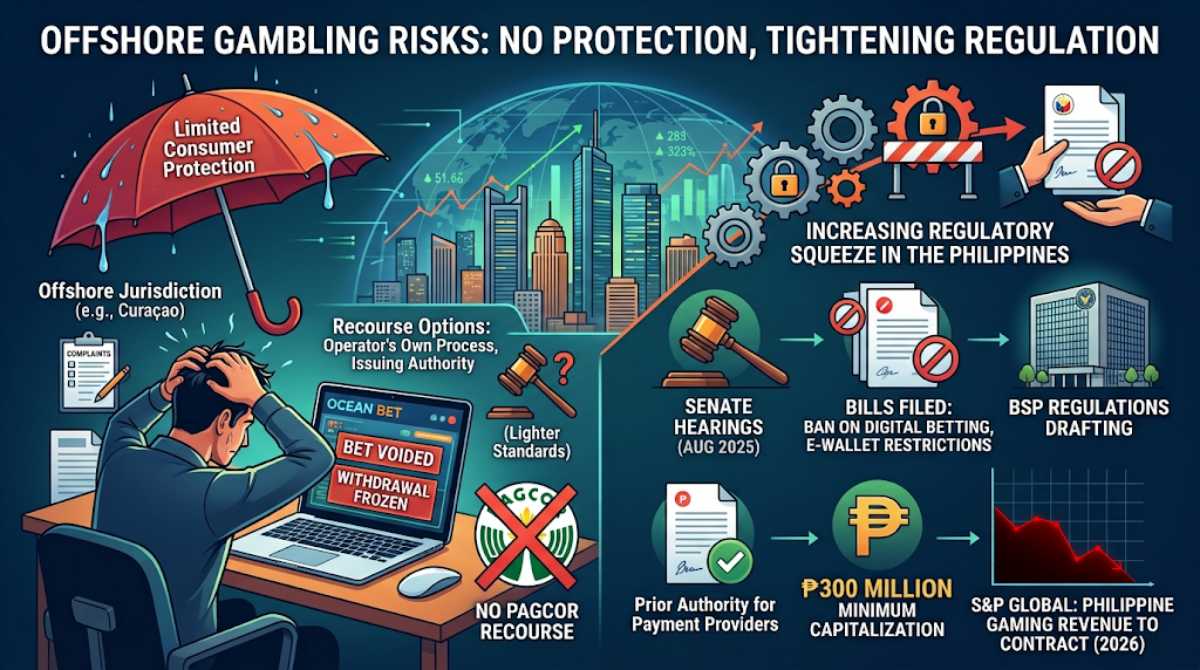
Offshore sportsbooks operate under foreign licences, mostly Curaçao, and target Filipino players from outside Philippine jurisdiction. They are not authorised by PAGCOR, and the government has moved firmly against unlicensed and offshore gaming: Executive Order No. 74 of November 2024 banned offshore gaming operations in the country. This guide therefore does not review or recommend any offshore book, and nothing on this page is legal advice.
What you definitively give up offshore is recourse. If an offshore book voids your bet or freezes your withdrawal, PAGCOR cannot help you, which is why offshore books are not recommended. Your only routes are the operator’s own complaints process and the issuing licence authority, and Curaçao’s consumer-protection standards are considerably lighter than the UK’s or Malta’s.
The regulatory direction of travel is also worth knowing. Since the August 2025 Senate hearings on online gambling, bills have been filed ranging from tighter e-wallet restrictions to an outright ban on digital betting, and the BSP has been drafting rules that would require any payment provider handling gambling transactions to obtain prior authority and meet a minimum capitalisation threshold reported at ₱300 million. S&P Global expects Philippine gaming revenue to contract in 2026 as a result of the squeeze. Expect the payment landscape to keep moving.
The minimum age is 21
The legal minimum gambling age in the Philippines is 21, not 18. PAGCOR-licensed platforms enforce it through identity checks. Some offshore sites display an 18+ notice because that is their foreign licence standard, which is another sign they do not follow Philippine rules: the legal age in the Philippines is still 21.
Do you pay tax on betting winnings in the Philippines?
Philippine tax law applies withholding tax to gambling prizes and winnings above a threshold set by the Bureau of Internal Revenue, with amounts below that threshold potentially falling under ordinary income tax rules instead. Rates and thresholds change, so confirm the current figures with the BIR or a Philippine tax professional rather than with a betting site.
The practical point: a PAGCOR-licensed domestic operator may withhold at source, while an unlicensed offshore book will not deduct or remit anything on your behalf, which leaves any reporting obligation entirely with you and is one more reason to stay with licensed operators. This is informational, not tax advice, if you win a meaningful sum, get proper guidance before you file.
How PAGCOR Oversees Sports Betting Sites in the Philippines
PAGCOR was set up as a government-owned and controlled corporation, and its charter, Presidential Decree No. 1869 of 1983 as later amended by Republic Act No. 9487 in 2007, gives it a dual role. It runs casinos of its own and it licenses and supervises private gaming operators. That combination is unusual by international standards, and it explains why the same body appears both as a brand on casino floors and as the authority whose approval a private sportsbook needs.
In practice, PAGCOR’s licensing covers land-based casinos, electronic gaming sites, bingo, sports betting and online gaming offered to people located in the Philippines. Each licensee has to meet requirements on capitalisation, player identification, anti-money-laundering controls, responsible gaming tools and the remittance of fees and taxes. When PAGCOR licenses an online platform for local players, those obligations come with it, which is the protection you lose the moment you sign up with an offshore book.
A small number of economic zones, such as the Cagayan Economic Zone Authority area, have historically issued their own gaming licences within their territories. Those zone licences were never a route for an operator to offer online betting to the general Philippine public, and for a bettor based in Manila, Cebu or Davao the reference point remains PAGCOR.
Online betting sites and retail betting in the Philippines
Regulated sports betting in the Philippines reaches players through two channels. The first is PAGCOR-licensed online platforms, which register players inside the country, run identity checks against the legal age of 21 and pay winnings through domestic payment rails. The second is licensed retail: sportsbook counters inside integrated resorts and casinos, and licensed betting stations. Both sit under the same regulator and the same dispute process.
If you prefer to bet in person, retail counters also remove most of the payment questions covered later in this guide, because you stake and collect on site. The trade-off is market depth and convenience, which is why most recreational bettors now use the licensed online channel instead.
Why Offshore Sportsbooks Are Not Recommended
Offshore sportsbooks are not licensed in the Philippines and are not recommended on this page. Many of them hold a licence from Curaçao or a similar jurisdiction, advertise in English and Filipino, and accept Philippine pesos or crypto. None of that makes them authorised to serve Filipino residents, and the practical risks are concrete rather than theoretical.
- No domestic recourse. PAGCOR has no power over an operator it has not licensed. A voided bet, a confiscated bonus balance or a frozen withdrawal has to be fought with the operator itself.
- Weaker player protection. Foreign licensing bodies differ widely in how they handle complaints, and some have very limited consumer protection standards compared with established regulators.
- Payment exposure. Because local banks and BSP-supervised e-wallets restrict gambling transactions, offshore books steer players towards crypto, agents and third-party transfers that offer no chargeback rights.
- Data and identity risk. Uploading ID documents to an operator outside Philippine jurisdiction means your personal data is handled under rules you cannot enforce.
- Policy risk. The government has tightened its stance on unlicensed and offshore gaming, and payment channels used by offshore books can be closed with little notice, leaving balances stranded.
If you already hold an account with an offshore book, the safest course is to withdraw any balance you can, stop depositing, and move your betting to a PAGCOR-licensed platform or a licensed retail sportsbook.
What the Future Holds for Online Betting in the Philippines
Philippine gambling policy has moved quickly since 2024. The offshore gaming industry was shut down under Executive Order No. 74, the August 2025 BSP memorandum cut the link between e-wallets and gambling sites, and the Senate has heard proposals ranging from stricter payment rules to much tighter limits on online betting as a whole. Proposals to separate PAGCOR’s regulatory role from its operating role have also been discussed for years.
For bettors, the direction is clear even where the detail is not: the regulated, PAGCOR-licensed channel is where legal betting will continue, and anything outside it carries growing legal and practical risk. Follow announcements on PAGCOR‘s official website and from the BSP rather than relying on betting forums or affiliate sites for news of changes.
Payment Methods for Online Betting Philippines Sites
This is where most Philippines betting guides are out of date, so here is what actually happened.
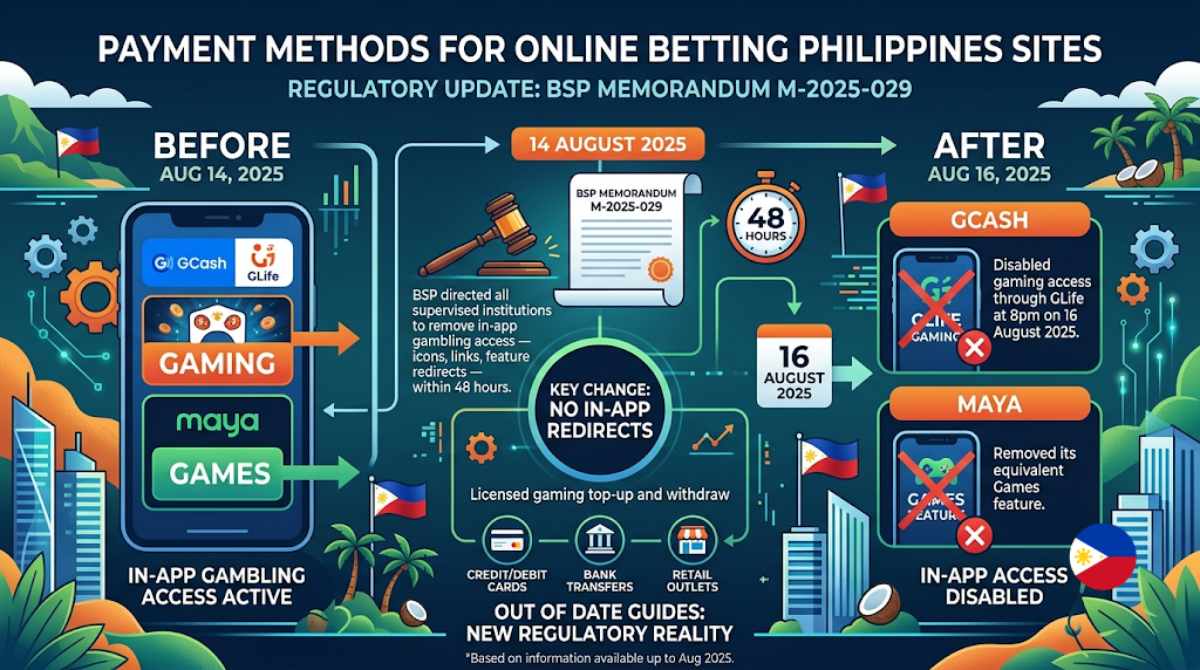
On 14 August 2025 the BSP issued Memorandum M-2025-029, directing all BSP-supervised institutions to remove in-app gambling access, icons, links and any feature redirecting a user to a gaming site, within 48 hours. GCash disabled gaming access through GLife at 8pm on 16 August 2025, and Maya removed its equivalent Games feature. Licensed gaming top-up and withdrawal services inside the GCash app were removed entirely. The suspension holds until the BSP finalises its policy on online gambling payment services.
The nuance almost everyone misses: the memo targeted in-app links, not e-wallet payments as a category. Senators noted at the hearing that bettors could still visit gambling sites directly and pay with their e-wallets, because the order only covered in-app connections. So the shortcut route, tap a gaming tile inside GCash, top up, bet, is gone. Whether a GCash or Maya deposit still completes on a given sportsbook’s cashier now depends on how that operator’s payment processor is coded, and it is inconsistent enough that you should not count on it.
| Method | Deposit | Withdrawal | What Filipino bettors should know |
| Crypto (USDT, BTC, ETH) | Not a standard route | Not a standard route | Mainly used by unlicensed offshore books. Not recommended; check the payment methods listed by a PAGCOR-licensed platform instead. |
| Maya / GCash (direct on-site) | Minutes to hours | 1 to 3 days | In-app gaming access is gone. Direct cashier deposits sometimes work, sometimes decline. Test small. |
| Bank transfer (BDO, BPI, Metrobank) | 1 to 3 days | 3 to 5 days | Secure and good for larger sums, but slow, and some banks block gambling-coded transactions. |
| Debit / credit card | Minutes to hours | 3 to 7 days | Success rate varies sharply by issuing bank; PH-issued cards are often declined for gambling-coded transactions. |
| International e-wallets (Skrill, Neteller) | Minutes | 1 to 2 days | Availability varies; confirm on the licensed platform’s cashier before depositing. |
You will see crypto promoted heavily as the “workaround” for Philippine payment controls. That route belongs to offshore books that are not licensed by PAGCOR, and it removes the protections that regulated payments give you, from chargeback rights to a domestic dispute route. Our advice is to use the bank, card or e-wallet methods a PAGCOR-licensed platform supports, test with a small amount first, and complete one withdrawal before depositing more.
A practical routine works best. Before you deposit, read the licensed platform’s payment page and note the minimum deposit, the minimum withdrawal, any fees and the stated processing times for each method. Use a payment method in your own name, because licensed operators match the account holder to the payment source as part of their anti-money-laundering checks, and a mismatch is a common reason for a withdrawal to be held. Keep records of deposits and withdrawals, including reference numbers, so that a disputed transaction can be raised with the operator and, if needed, with PAGCOR.
If a payment is declined, do not switch to an agent, a friend’s account or a crypto workaround suggested in a chat group. Contact the licensed operator’s support team, ask which methods currently work for your bank or e-wallet, and wait for a supported route. Rules and processor arrangements have changed several times since 2025, and the licensed operator is the party responsible for telling you what is allowed today.
Most Popular Sports to Bet On in the Philippines
Basketball: NBA and PBA
Basketball is the national sport and the dominant betting market by volume. NBA action carries the deepest menus, moneylines, spreads, totals, player props and same-game parlays, with betting volume spiking around Lakers and Warriors games, which retain the largest Filipino followings.
PBA coverage is the real differentiator. Ginebra remains the biggest domestic draw and Ginebra games consistently generate the heaviest local turnover, but many international books either skip the PBA or offer moneylines only. If local league betting is central to how you bet, verify PBA lines exist and go beyond the moneyline before you fund an account. FIBA windows and Gilas Pilipinas fixtures attract similar interest and similar coverage gaps.
Boxing and MMA
Manny Pacquiao’s legacy keeps boxing culturally central, and the current generation, fighters like Melvin Jerusalem and Eumir Marcial, still stops the country when they fight. Most regulated books price major world title bouts; the variable is depth. Method-of-victory and round-group markets are where the value sits for bettors who study styles, and those are not universally offered. UFC and MMA are the fastest-growing combat category, so check the fight-night menu depth before you commit.
Esports
The Philippines has one of Southeast Asia’s most active esports scenes, driven by Mobile Legends: Bang Bang and Dota 2, with Blacklist International giving local fans a genuine contender to back. Available markets go well past match winner: map handicaps, total maps, first blood and objective props are standard at the better books. Check that the licensed platform you use covers the MPL Philippines and the major Dota 2 events before you rely on it for esports. Esports markets also attract a large number of unlicensed offshore books and informal betting groups on social media, which are not recommended; keep esports bets on the same PAGCOR-licensed platform you use for basketball and football, and apply the same limits.
Football
Football interest is growing and is driven almost entirely by the Premier League and Champions League rather than domestic competition. A good book covers the major European leagues with Asian handicap, both-teams-to-score, correct score and full in-play menus, and compare margins on EPL fixtures, where pricing differences are easiest to spot.
Bet Types Explained
- Moneyline, Pick the winner, nothing else. If San Miguel is priced at -150 they are favoured and you risk ₱150 to win ₱100; a +130 underdog returns ₱130 on a ₱100 stake. The right starting point.
- Point spread, The favourite concedes points to level the contest. Gilas at -8.5 must win by nine or more; back the underdog at +8.5 and they can lose by eight and you still collect. You are betting on margin, not outcome.
- Over/under (totals), Wager on the two teams’ combined score against a set line, say 225.5 in an NBA game. Useful when you can read tempo but not the winner.
- Parlay, Multiple selections on one ticket at multiplied odds. Every leg must land. Same-game parlays let you combine markets within a single match, and they are heavily juiced, enjoyable, but the house edge is significantly higher than on singles.
- Futures, Long-term outright bets: PBA Philippine Cup winner, NBA champion, tournament top scorer. Long odds, months of exposure, small stakes recommended.
- Props, Bets on events inside a game rather than the result. Player points and rebound lines, corner counts, cards. The most rewarding market for anyone tracking individual form and matchups closely.
- Live betting, In-play wagering with odds that move in real time. A favourite trailing by 10 in the first quarter drifts to a better price. Rewards bettors who read momentum, and punishes those who chase.
Betting Apps and Mobile Sites
Filipino bettors rely mainly on mobile devices to access online sports betting Philippines platforms. Some PAGCOR-licensed platforms offer dedicated apps, while others rely on mobile-optimised browser sites, so check what the licensed operator actually provides rather than downloading an app from an unofficial source.
That gap matters less than it sounds. Google Play and the App Store restrict real-money gambling apps in many jurisdictions, so many betting platforms lean on HTML5 sites that run full-featured in Chrome, Safari or Brave, cost no storage, and update instantly. Pin the site to your home screen and the practical difference from an app is close to nil. What genuinely matters on a mid-range Android over mobile data is load time and how quickly the bet slip responds when a live line moves, and on that measure a well-built browser site regularly beats a heavy native app.
Bonus Types at Philippine Betting Sites
- Welcome match, A percentage of your first deposit in bonus funds. Always divide the headline figure by the rollover before judging it. A small offer at 5x is worth more in practice than a four-figure offer at 60x.
- Cashback, A percentage of net losses returned, usually weekly. Zero-wagering cashback is the strongest structure of this type, because withdrawable cash beats bonus credit.
- Reloads and rebates, Recurring offers on later deposits or on turnover. Weekly reloads and VIP ladders reward sustained volume rather than a single opening deposit.
- Free bets, A fixed stake awarded outright; you keep the profit, not the stake. Prediction contests often pay out this way.
- Odds boosts and parlay boosts, Enhanced prices on selected markets, or a percentage added to winning multi-leg tickets.
Two rules for clearing any of it. Keep bonus turnover on the sportsbook rather than the casino at hybrid platforms, casino play usually carries a higher multiplier. And check which markets actually contribute: live betting, very short odds and certain sports are frequently excluded from rollover.
The Verdict
The best sports betting sites Philippines bettors can use are the ones licensed by PAGCOR. Offshore books licensed in Curaçao or elsewhere may advertise bigger bonuses, more markets or crypto payments, but they are not authorised in the Philippines, give you no domestic recourse and are not recommended. Choose a PAGCOR-licensed platform or a licensed retail sportsbook, check PBA and NBA depth, and read the bonus terms before you deposit.
Whichever you choose, do three things before you deposit meaningfully: verify the PAGCOR licence on PAGCOR’s own website, confirm the specific markets you plan to bet actually exist at the depth you need, and complete one small withdrawal end to end. Every claim on this page can be checked, and the ones worth most to you are the ones you check yourself.
Frequently Asked Questions
The best choice is a platform licensed by PAGCOR, the Philippine Amusement and Gaming Corporation, because it is the only route authorised for Filipino residents and the only one with a domestic dispute process. Check the operator on PAGCOR’s official website, confirm it offers the PBA and NBA markets you want, and read the bonus terms before you deposit. Offshore books are not recommended.
Betting through PAGCOR-licensed operators is legal and regulated. Offshore sportsbooks are not licensed by PAGCOR to serve the Philippines, and the government banned offshore gaming operations under Executive Order No. 74 in November 2024. Offshore books are not recommended, and PAGCOR cannot help you in a dispute with one. The minimum age is 21.
Not through the app. BSP Memorandum M-2025-029 removed all in-app gaming access and licensed gaming top-up services from GCash as of 16 August 2025, and Maya did the same. The order covered in-app links rather than e-wallet payments as a whole, so check which payment methods a PAGCOR-licensed platform currently supports on its own cashier.
Coverage varies, which is why it is worth checking first. Before registering with a PAGCOR-licensed platform, open the basketball section during a PBA game window and confirm that it offers handicaps and totals rather than moneylines alone.
It depends on the method and on verification. At licensed platforms, e-wallet withdrawals typically run one to three business days, cards three to seven, and bank transfers three to five. Complete identity verification before your first withdrawal request rather than during it, because unfinished KYC is the most common cause of delays.
No. Crypto is mainly used by unlicensed offshore books that are not authorised in the Philippines and are not recommended. Use the bank, card or e-wallet methods supported by a PAGCOR-licensed platform instead.
Offshore betting sites are not licensed by PAGCOR, are not authorised to serve Filipino residents and are not recommended. A Curaçao or Kahnawake licence gives you no Philippine recourse if a bet is voided or a withdrawal is frozen. The safe option is a PAGCOR-licensed platform, which you can verify on PAGCOR’s official website.
Responsible Gambling
Betting is entertainment, not income, and the Philippines has spent the past two years confronting exactly what happens when that line blurs, Senate hearings in 2025 heard evidence of rehabilitation facilities where a majority of new admissions were being treated for online gambling addiction.
Set a deposit limit before your first bet, not after a bad night. Never chase losses; it is the fastest route from a hobby to a financial problem. Use the deposit caps, reality checks, cool-off periods and self-exclusion tools the platform provides, and if a site does not offer them, that tells you something about the site.
If gambling is causing harm to you or someone close to you, support is available:
You must be 21 or older to gamble in the Philippines. Gambling in the Philippines is regulated by PAGCOR; check any operator against PAGCOR’s official information before you register.