
Online poker has a real following in the Philippines, and these days most of it happens on a screen rather than at a table in Makati or Manila. Filipino players who want to play for real money have plenty of rooms to pick from, but not every site treats you the same way once you actually sit down and play. This guide walks you through the best online poker sites in the Philippines: what separates a top poker room from an average one, how to sign up and make your first deposit with GCash, Maya or bank transfer, which games and formats you will find in the lobby, how rakeback and bonuses really work, and what the mobile apps and the live scene in Manila have to offer.
Best Online Poker Sites in the Philippines
The best online poker site in the Philippines is the one that fits the way you play. A tournament grinder needs a deep schedule with solid guarantees, a cash game regular needs steady traffic at the right stakes, and a casual player mostly wants a smooth app and easy peso payments. Rather than chasing the biggest headline bonus, these are the qualities that the top poker rooms for Filipino players have in common.
- Peso accounts and local payments – deposits and withdrawals in pesos through e-wallets such as GCash and Maya or a standard bank transfer, so you are not losing money on currency conversion
- Reliable withdrawals – cash outs that are processed quickly and consistently, with clear limits and no surprise fees
- Traffic at local peak times – full tables during evening hours in Manila, not just at global peak times
- Rakeback that lands in your account – a rewards program you can actually measure at the end of the month
- A strong mobile client – most Filipino players sit down on a phone first, so the app has to be fast and easy to use
In-Depth Look at Online Poker Sites in the Philippines
When we take a closer look at an online poker site, we go beyond the promotions page and look at what it is like to play there week after week. The first thing we check is the player pool. A room with plenty of recreational traffic at the micro and low stakes makes for softer games, while a small pool means the same regulars at every table and long waits for a seat. We also look at how the traffic is spread across games, since a site can be busy at No Limit Hold’em and almost empty at Pot Limit Omaha.
The software matters just as much. A good poker client lets you take notes on opponents, tag players with colours, resize tables, and switch between cash games and tournaments without hunting through menus. Tournament schedules are another big differentiator: some rooms run daily multi table tournaments with guarantees at several buy in levels, while others focus on sit and goes and fast formats. Finally, we look at how quickly the cashier works in practice and how helpful customer support is when a deposit or withdrawal needs attention.
How to Vet an Online Poker Site in the Philippines
You do not need to commit a big bankroll to find out whether a poker room suits you. Open an account, make a small first deposit, and play a few sessions at low stakes to get a feel for the software and the traffic. Then request a small withdrawal early on. How fast it arrives and how smooth the verification process is will tell you more about a site than any review. While you are at it, send a question to customer support through live chat or email and see how quickly and clearly they respond.
It also helps to read the key terms before you play. Check the minimum and maximum withdrawal amounts, any fees for specific payment methods, how the welcome bonus is released, and whether rakeback is paid as cash or as points that need to be converted. A site with clear, readable terms is usually a site that is easy to deal with when something needs sorting out.
How to Register and Start Playing
Signing up for online poker follows a fairly standard path at most rooms. Here is what the process looks like from start to finish, so you can go from choosing a site to sitting down at your first table without any surprises.
Step 1: Pick the Right Room for You
Start with what actually matters for your own online poker game, not the biggest welcome bonus. If you want a peso account with GCash or Maya in the cashier, focus on rooms that offer local payments. If you mainly play tournaments, compare schedules and guarantees. If you play on your phone, try the app before you deposit. Check that the site accepts players registering from the Philippines before you go any further.
Step 2: Create Your Account
Registration for online poker usually asks for your name, email, date of birth, and a password. Double check the birth date field especially, since a mismatch with your ID can hold up verification later. Some rooms also ask for a local mobile number and address. If the room you picked has a bonus code, this is where you enter it, not after your first deposit.
Step 3: Verify Your Identity
Most online poker sites require KYC (know your customer) checks before your first withdrawal, so it is worth uploading a valid ID early rather than waiting until you actually want your money out. A passport, driver’s license, or a national ID is the usual requirement, sometimes together with a recent proof of address. Getting this done up front means your first cash out is not held up.
Step 4: Make Your First Deposit
At rooms that offer peso banking, e-wallets such as GCash and Maya and bank transfer typically sit right in the cashier. Peso channels are what PAGCOR-licensed platforms are built around. Start with a smaller test deposit the first time you use a new payment method, just to confirm everything lands correctly before you start playing online poker for real money.
Step 5: Claim Your Welcome Bonus
Many rooms credit the bonus automatically once your online poker deposit clears, though some release it in increments as you generate rake rather than all at once. Read the terms before you deposit a large amount specifically to chase a bonus, since the wagering requirement affects how quickly, or whether, you will actually see that money.
Step 6: Sit Down and Play
After topping up your account, you're free to sit down at a cash table, sign up for a tournament, or dive straight into a faster format from the lobby. When you're still finding your feet with a new online poker room's software, begin at a stake level whose loss wouldn't bother you, and only raise it once you're comfortable navigating the interface. Setting a deposit limit at the same time keeps your bankroll on track.
What to Look For in Online Poker Sites in the Philippines
A big welcome bonus does not tell you much on its own, so it pays to compare online poker rooms on a handful of practical questions instead of marketing copy.
- How fast are withdrawals in practice, and are there fees or minimums for your preferred method?
- Are deposits and withdrawals offered in pesos through local payment channels?
- Is there enough traffic during evening hours in Manila for the games and stakes you play?
- Are bonus and rakeback terms published clearly, including wagering and expiry?
- Does the mobile app or site run well on a phone, since most Filipino players sit down on mobile first?
- How good is customer support when something actually goes wrong with a deposit?
Withdrawals and payments come first on this list for a reason: a room with great games is only worth your time if your winnings reach you quickly and without hassle. After that, traffic and rakeback decide how good the games are and how much of your money you keep over a month of play.
How Online Poker in the Philippines Is Run
Gambling in the Philippines is regulated by the Philippine Amusement and Gaming Corporation, better known as PAGCOR, which both regulates and operates gaming in the country, a dual role it has held since its charter back in 1983. PAGCOR issues licenses that cover everything from a land based casino floor to an online casino platform, and poker sits inside that same framework. The minimum age for gambling is 21. You can see which operators currently hold a licence on PAGCOR’s official website, pagcor.ph, which publishes its lists of licensed and accredited gaming operators.
You may also have read about the Anti-POGO Act of 2025 (Republic Act No. 12312). POGOs were Philippine Offshore Gaming Operators licensed to serve players in other countries rather than Filipino players, and the act closed down that export industry. It did not change how online poker works for players in the Philippines.
Payment Methods for Filipino Poker Players
How you get money in and out matters just as much as which poker room you pick. The right payment method saves you conversion fees, speeds up your withdrawals, and makes it easy to keep track of your bankroll.
Depositing with GCash and Maya
GCash is the most widely used e-wallet in the Philippines, so it makes sense that most online poker players want to use it directly. Rooms that offer peso banking usually list e-wallets such as GCash and Maya alongside standard bank transfer. Check the cashier of the site you choose to see which methods it supports for deposits and which for withdrawals, since the two lists are not always the same.

E-wallet deposits are usually instant, which means you can top up and be seated at a table within minutes. Withdrawals back to the same e-wallet tend to be the quickest way to cash out, while bank transfers can take a little longer depending on your bank. Using the same method in both directions also keeps verification simple.
Crypto and Online Poker in the Philippines
Crypto poker rooms are a large part of the advertising Filipino players see. Those rooms generally hold a licence from another jurisdiction rather than from PAGCOR, while PAGCOR-licensed platforms run on peso accounts and local payment channels such as GCash, Maya and bank transfer. Where crypto does appear in poker marketing, USDT is the coin mentioned most often because it tracks the US dollar, with BTC, ETH and USDC as the other common names.

It helps to know how crypto payments differ from peso e-wallets before you compare the two. A blockchain transfer cannot be reversed once it is confirmed, there is no bank or e-wallet provider to raise a dispute with, and the value of coins other than stablecoins can move between the moment you send and the moment you play. Peso e-wallets, by contrast, are covered by the Bangko Sentral ng Pilipinas rules for electronic money issuers and keep every transaction in your own transaction history.
Taxes on Poker Winnings in the Philippines
This is the part most online poker guides either skip or oversimplify, so it deserves a straight answer. At a locally licensed operator, prizes and winnings above PHP 10,000 face a 20 percent final withholding tax, taken automatically before the money reaches your account. You never see that portion, since the operator remits it directly.
As a Philippine resident, income from other sources is reportable on your annual tax return as other income, where graduated rates from 0 to 35 percent apply depending on your total earnings for the year. If poker makes up a real share of your income, a short conversation with a Philippine tax professional is a lot cheaper than guessing wrong.
Popular Poker Games and Formats
Most online poker platforms run the same core games, though the exact mix and stakes shift from site to site.
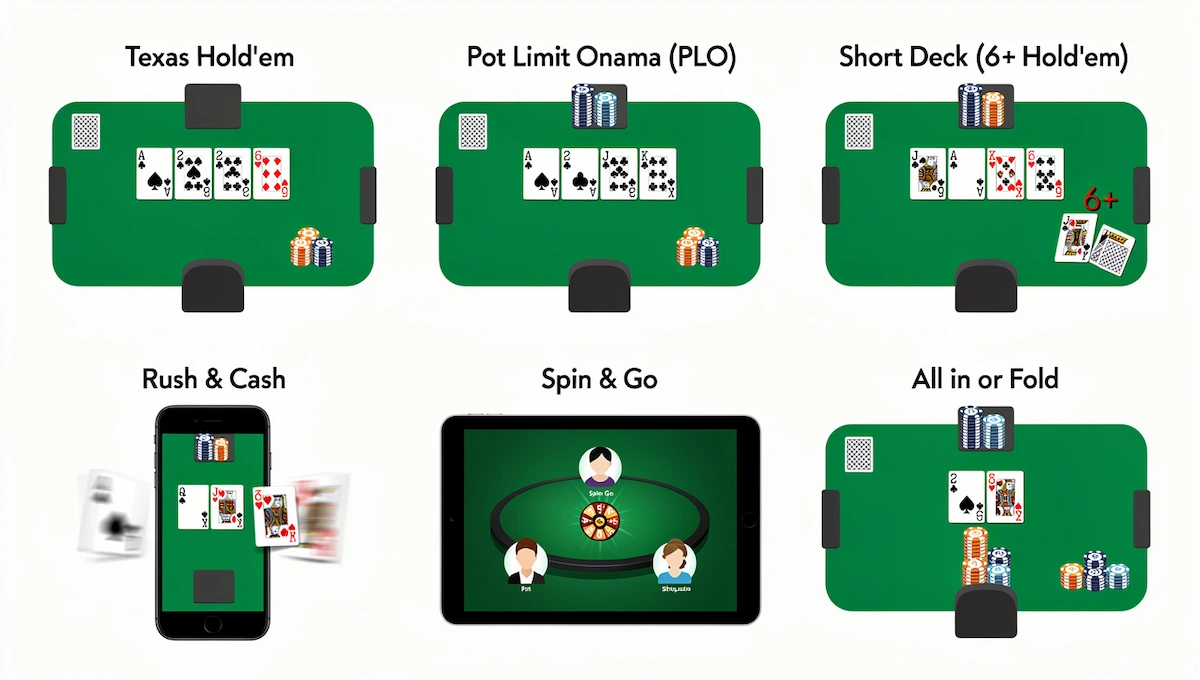
- Texas Hold’em – the standard game everywhere, played in No Limit at almost every stake
- Pot Limit Omaha (PLO) – four hole cards instead of two, with bigger swings and bigger pots
- Short Deck (6+ Hold’em) – a stripped deck that speeds up the action and changes hand values
- Rush and Cash or fast fold formats – you fold into a brand new hand instantly, so you play far more hands per hour
- Spin and Go or jackpot sit and goes – three handed tournaments with a random multiplied prize
- All in or Fold – every decision is either shove or fold, popular with players who want short sessions on mobile
Multi table online poker tournaments run daily on larger platforms, with weekend schedules usually carrying the biggest guarantees. Check which formats a room actually offers before you sign up, since smaller platforms may only run a few of them.
Mobile Poker Apps for Philippine Players
Most online poker traffic now comes from a phone rather than a desktop, and poker apps have caught up accordingly. A good mobile client should be close enough to the desktop version that playing more than one table feels natural rather than cramped.

Some platforms offer a downloadable app, while others run in a mobile browser with no download at all, which suits anyone who switches devices often or plays on shared data. Download apps from official app stores or the poker room’s own site. If you plan to run six or eight tables at once, a laptop is still the better tool, but for a casual session on the train home, a well built mobile client will get the job done.
Rakeback and Bonuses Explained
Rake is the quiet cost of every hand you play in online poker, and on the smaller stakes it is often the actual difference between a small winner and a small loser over the course of a month. Welcome bonuses grab attention, but the ongoing rakeback or loyalty program matters far more over time. Headline rakeback percentages are often scaled down by tiers or player value formulas, so the real number usually lands below the advertised figure.
Some platforms pay a flat percentage you can plan around, while others use races, missions, and loyalty tiers that reward volume and activity over a set percentage. Whichever room you use, judge the reward system by what actually lands in your account at the end of the month rather than the number printed on the promotions page, and read the terms before you opt in.
Live Poker in the Philippines
Online poker gets most of the attention in a guide like this, but the live scene in Manila is real and growing. Permanent poker clubs and casino card rooms regularly spread cash games and tournaments across the country, most of them licensed by PAGCOR, and live rake is usually higher than what you pay online, so check the rake structure posted at the table.

Resorts World Manila and Okada Manila both run regular series with a mix of No Limit Hold’em and Omaha, and Metro Card Club hosts stages of the Asian Poker Tour and the Filipino Poker Tour throughout the year. The same land based venues that run poker floors typically run a sportsbook alongside the tables, since Philippine casino licenses tend to bundle several forms of gambling under one roof rather than issuing separate licenses for each game.
Responsible Gambling
Online poker is meant to be entertainment, and good poker rooms give you tools that help you keep it that way. With deposit limits, you set a cap on how much goes into your account over a day, a week, or a month. Session and reality check reminders show you how long you have really been sitting at the table. Self exclusion locks your account for a set period if you want a longer break. Play with money you have set aside specifically for poker, and think of any winnings as a bonus, never as income you are counting on.
If poker starts to feel like a way to fix a money problem rather than a form of entertainment, take a break and talk to someone. The National Center for Mental Health (NCMH) crisis hotline on 1553 offers free, confidential support nationwide, and Gambling Therapy offers free online support in several languages.
Conclusion: Which Poker Site Should You Choose?
The right poker site for you depends on how you play. Start with the basics that affect every session: peso payment options such as GCash and Maya, fast and reliable withdrawals, and enough traffic in the evening for the games and stakes you actually play. Then compare the details that add up over time, from the tournament schedule and the quality of the mobile app to the clarity of the bonus terms and the real value of the rakeback program. Keep your KYC documents ready so your first cash out is smooth, set a deposit limit from day one, and judge any rewards program by what actually shows up in your account rather than the number on the landing page.
FAQ
Online gaming in the Philippines is regulated by PAGCOR, which licenses operators for different types of gaming, including online platforms. The minimum age to gamble in the country is 21, and operators verify your age and identity as part of the sign up process.
Texas Hold’em is the most popular game at every stake, followed by Pot Limit Omaha. Many rooms also offer Short Deck, fast fold cash games, Spin and Go style jackpot sit and goes, All in or Fold tables and daily multi table tournaments with bigger guarantees at the weekend.
Yes, at rooms that offer peso banking. GCash and Maya usually sit in the cashier alongside bank transfer, and e-wallet deposits are typically instant. Check the cashier of the site you choose, since deposit and withdrawal options are not always the same.
Rakeback returns part of the rake you pay at the tables, either as a flat percentage or through loyalty tiers, races and missions. Headline percentages are often scaled down by tiers, so judge a program by what actually lands in your account at the end of the month.
At a locally licensed online poker site, winnings above PHP 10,000 face a 20 percent final tax taken automatically before you receive the money. Other income is reportable on your annual tax return, so speak to a Philippine tax professional if poker is a significant part of your income.
Beginners do best at a room with plenty of low stakes tables, a smooth mobile app, peso payments and clear bonus terms. Start with a small deposit, play micro stakes while you learn the software, and set a deposit limit from the start.
Yes, and most Filipino players already do. Some rooms offer a downloadable app while others run in the mobile browser. Download apps from official app stores or the poker room’s own website, and set deposit limits in the app from the start.
Manila has the busiest live scene. Resorts World Manila and Okada Manila run regular series with No Limit Hold’em and Omaha, and Metro Card Club hosts stages of the Asian Poker Tour and the Filipino Poker Tour throughout the year.