
It’s been nearly a decade since I completed Thatgamecompany’s adventure title, Journey; playing through it on my then newly purchased PS4 during an inconsequential afternoon, expecting it to be a light-hearted and cozy jaunt that would tide me over until my next “real” game for my powerful new system. As the credits rolled about two hours later however, I was entranced by what had just transpired. Wistful feelings of melancholia, nostalgia, and serenity permeated my mind and body, yet I couldn’t pinpoint exactly why such sensations were happening.
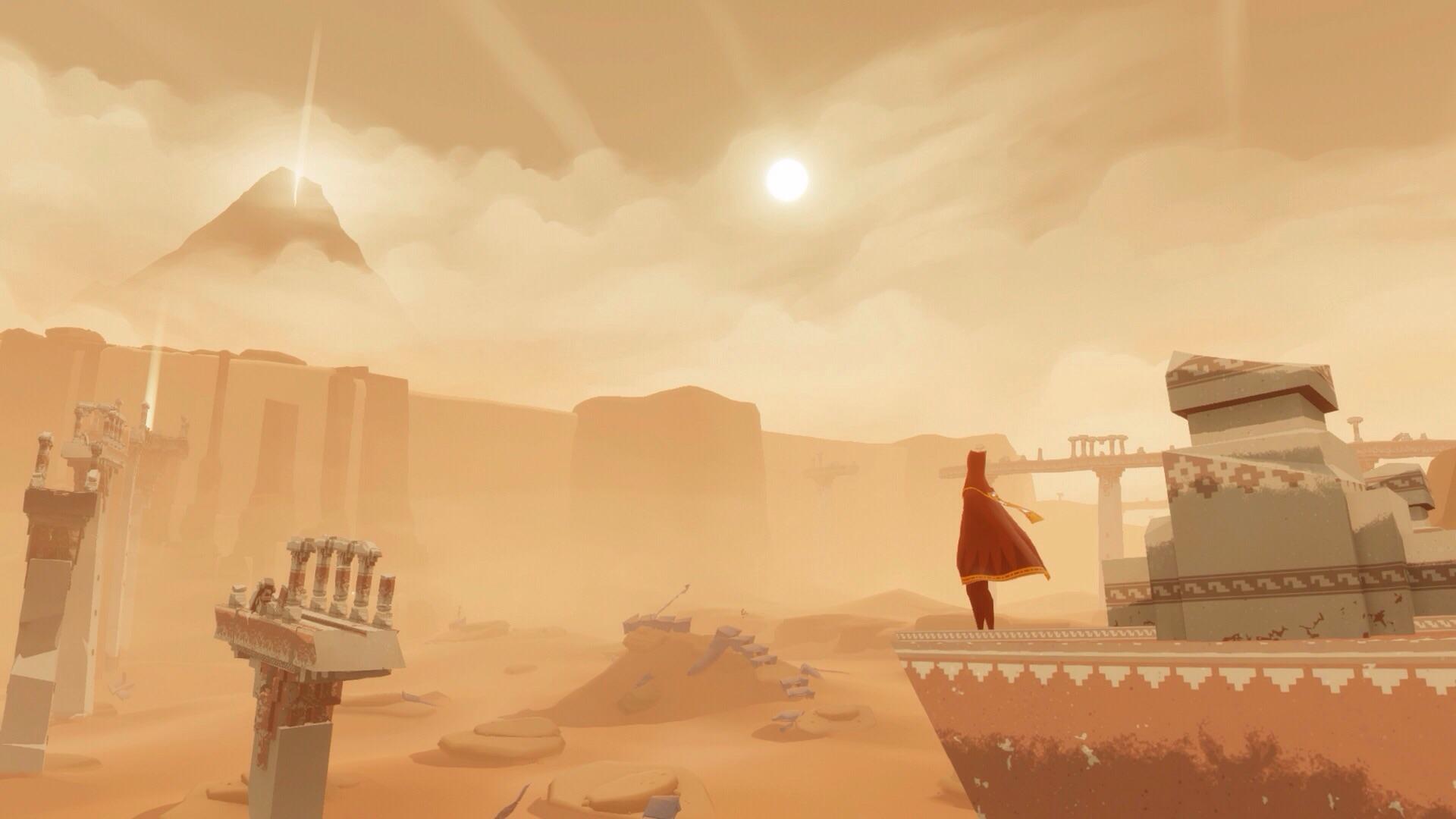
Because you see, Journey never told me what it was about. There were no lines of dialogue, no torn bits of paper with text that I could collect throughout my playthrough and piece together to have some idea of the game’s world or lore; nothing. The game began with no pomp nor circumstance, giving me control of this nameless hooded character almost instantaneously and without any introduction of who they were. I went on to guide this character through a barren desert and across dilapidated terrains of a world long gone, getting surprised when I came across another nameless traveller doing the same, then watched as this character transcended into the ether.

As the sun slowly set on my previously inconsequential but now vastly more interesting afternoon, I couldn’t understand what I’d just experienced. Journey would stay with me for the next few days as I found myself frantically digging around the deep edges of the internet trying to understand the story that I’d just been told. Yet, even after all this research, I wasn’t satisfied. Nothing fully captured the emotions I was feeling. There was this odd juxtaposition of fear and emptiness alongside a hopeful contentment that this game made me feel; all of which was bundled with a sense of frustration at not being fully satiated due to the game not having given me more in terms of tangible storytelling. It’s a ball of emotions that hasn’t truly been replicated for me with any game I’ve played since. This isn’t to say other games haven’t made me feel a swathe of emotions due to their narrative brilliance, far from it. In fact, I’d say there are dozens of games I’ve played since that have told a more narratively robust story with themes executed with more nuance and depth. They simply did so with more traditional storytelling methods.
Journey is different in that it does what I believe any piece of art should do, making one feel, in ways that forgo those traditions that stem from literature and cinema. Traditions that video games often cling to in lieu of harnessing the powers of other storytelling devices like music and atmospheric art design, both of which are often relegated as tangential elements that are used to simply add to the core gaming experience instead of being an active player in said experience. Furthermore, trusting that players are smart enough to figure things out and dropping them into this unknown world without any tutorial or direction is gutsy but creates a sense of instant immersion simply because of the jarring nature of it all. This immersion is then multiplied immeasurably by the evocative art design and the phenomenally composed – and Grammy-nominated – soundtrack by Austin Wintory. It all coalesces to create a sense of scale and wonder, which coupled with the game creating tactful ways to keep pushing you forward either via clever camera movements or changes in verticality, makes for an experience that you don’t want to put down until you reach its end, and even then you’re left yearning for more.
Some say Journey speaks about the “journey” of life, with you beginning as a “child” and making your way through adolescence and adulthood, to then eventually coming to life’s end until you eventually rise into the heavens. Others, conversely, think it’s about the sufferings before you actually enter the world, with your player-character acting as a sperm and the ending is them “getting out” into reality (yes, there are some who actually think this; bless them, poor things). Some take a more cerebral, ecocritical route believing the game to be a criticism of modernity and overexploitation, which leads to the destruction of our natural habitat. Though I can see both the first and last points, I’m not sure I fully grasp the story and themes of Journey. And frankly, I don’t think I care to. Because a story for me, in essence, is about what it made me feel. Sure I can put on my film degree hat and analyze the semiotics of it all, or pen my best journalistic phrases like “ludonarrative harmony,” but none of that will properly illustrate the unique and incommunicable feelings Journey impressed upon me, in ways so differently than any other game.
As mentioned, these feelings haven’t been replicated by a game since. Even games that take direct inspiration from Journey like Giant Squid’s Abzu, though decent in its own right, failed to elicit anything close to what Thatgamecompany’s masterpiece did for me. Some mention walking simulators like What Remains of Edith Finch or Ustwo Games’ puzzler, Monument Valley. Though I love both of those games and consider them some of the medium’s best, they still don’t match the emotional resonance of Journey. Primarily because their fundamental approach to design still relies on either the mechanics of how their game functions, or the in-game writing and dialogue that propels their story forward.
What separates Thatgamecompany is that their fundamental basis for creating a game stems from, as their former president Kellee Santiago states, “deciding on the emotions and feelings they wish to invoke in the player.” It’s this approach that I would love to see happen more often in the games industry, particularly in the indie space. Games that are more experiential and obtuse, focusing on utilizing the many other design elements that can explore rich themes in different, evocative ways that leave a lasting, emotional impression.