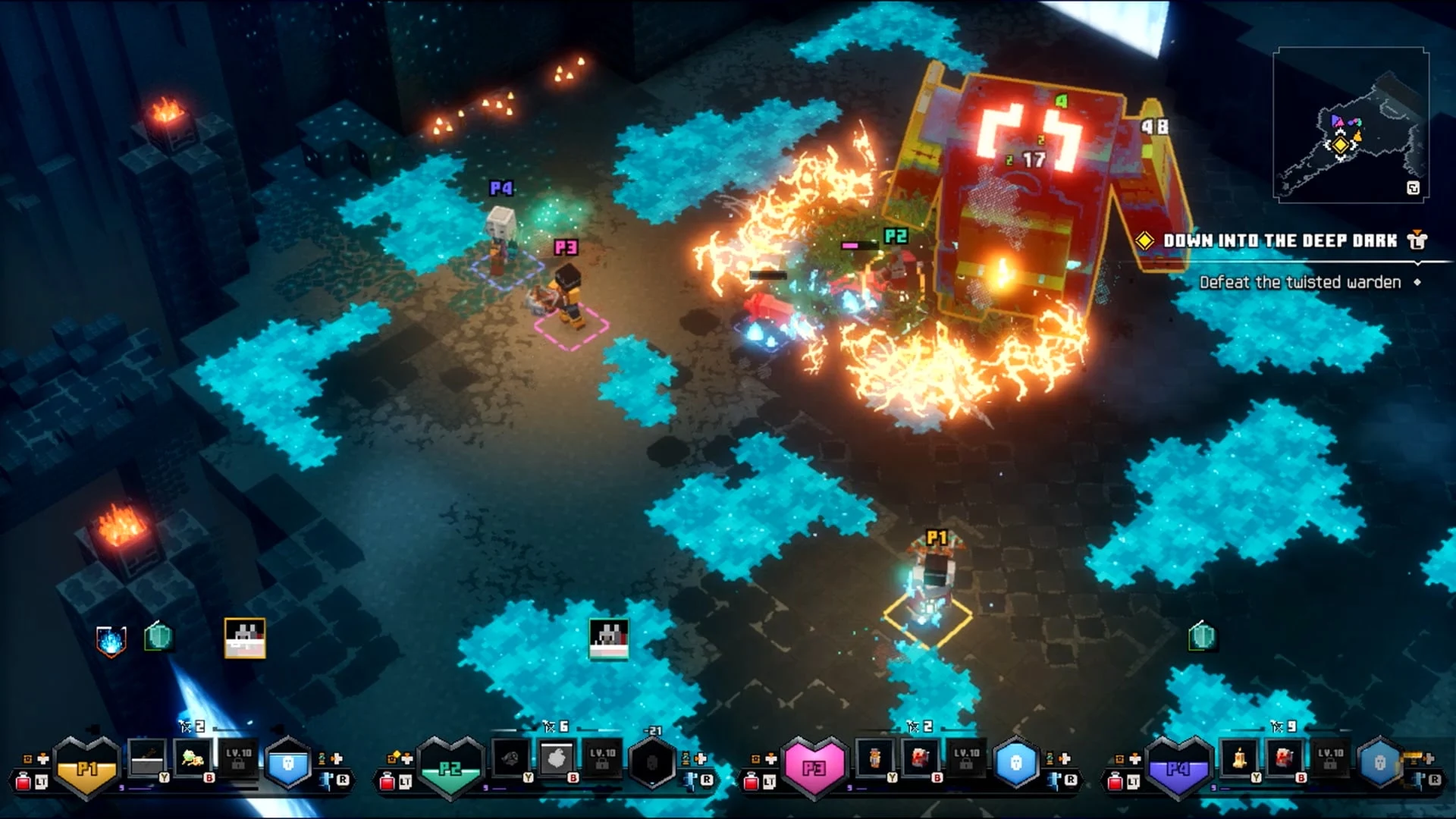
I went into the original Minecraft Dungeons expecting a licensed cash-grab and came out having sunk two full playthroughs into it, which surprised me more than it probably should have. It never got anywhere near the systemic depth of Diablo or Path of Exile, but there was real satisfaction in honing a build and watching it chew through blocky hordes of Illagers. Minecraft Dungeons 2 doesn’t try to reinvent that formula. Instead, it makes smart, deliberate improvements in almost every direction, and the result is a sequel that’s simply more of what made the first one work.
The pitch remains the same at its core: a short-form action RPG with no defined classes, where your identity is built entirely from equipment. You still pick a melee weapon and a ranged weapon, and your active skills come from three equipped artifacts rather than a talent tree. What’s changed is the amount of stuff Mojang gives you to build with, and how the game is structured around getting you there. The central quest still follows a preset path, but it now winds back and forth through a genuinely more open-world environment, dotted with side quests, optional dungeons, and rifts into a new realm.
That expanded toolset is where Minecraft Dungeons 2 earns its keep. Armor has gone from a single slot to four separate pieces, each carrying its own buffs and enchantments, and you now get three talisman slots on top of that for broader bonuses like extra XP, a higher max life pool, or a wolf companion that fights alongside you. Artifacts still cover a mix of returning favorites and new additions, including active skills that summon explosions, poison clouds, or swarms of helpful bees, though I found precise targeting on those a bit finicky once a fight got crowded. I got far more mileage out of the simpler buffs – elemental damage on my swings and arrows, temporary speed or defense boosts – than I did trying to land AoE skills in the chaos of a real encounter.
Enchanting is where the sequel gives you noticeably more control than before. Books unlock enchantments permanently, some tied to story beats and others as random drops, and once unlocked you can slot them onto any piece of gear you like. The catch is that you can only equip one enchantment per item now, so the wild, stacked combinations from the first game are gone. I still put together a sturdy heal-tank setup and, separately, a build that slowed groups with splitting ice arrows before diving in with rapid rolls and lightning daggers, and both had enough synergy that I could genuinely feel the difference between a good build and a lucky one. I’ll admit I miss some of the more extreme min-maxing the old system allowed, but the tradeoff is that less experienced players won’t get left behind by hardcore ARPG veterans, which feels like the right call for a game this accessible.
There’s also a fairly tight money cap early on that nudges you toward actually using what you find instead of hoarding gold for the merchant’s best-in-slot gear. I spent my early hours grabbing whatever had the highest numbers at the shop, which in hindsight pushed me into experimenting with weapon types I’d never have tried otherwise. By the time I unlocked the blacksmith and could just upgrade gear I already liked, I’d already been steered into a much wider spread of playstyles than I expected going in.
The new mini inventory lets you swap gear on the fly, which is fantastic in the early game when upgrades are coming constantly, though the deeper I got, the more I found myself digging through stacked enchantments and bonus effects before I’d trade anything out. Jumping is new too, and while every melee weapon can now pull off a midair slam that’s great for group initiation early on, I barely reached for it once my build settled in. A quest path you can pull up on demand is a nice touch for anyone who loses their bearings, even if I rarely needed it myself.
Mojang’s biggest structural addition is the Sift, a rainbow-stained realm you reach through interdimensional rifts, and it’s genuinely one of the sequel’s best ideas. The Sift dimension flips between two states as you explore it – Thrive, which makes your life easier, and Endure, which drops noticeably more punishing mobs on you – and you spend increasingly more time there as the story progresses. It would have been tempting for Mojang to lean even harder into this and let it swallow the whole game, but the balance between regular overworld areas and Sift sections felt right to me as it stands.
Optional dungeons and rifts are scattered across the map, and most of them are worth the detour for loot, unique gear, or a shot at a boss fight, though they’re not universally great – I ran into at least one dungeon that turned out to be little more than empty corridors. Small secrets like lighting four torches to unlock a floor vault, or clicking a suspicious wall to reveal a hidden treasure room, help paper over those weaker stretches. Boss fights are a clear upgrade from the original too; none of them are especially complex, but they demand constant movement and positioning, at least when you’re playing solo, and many drop unique gear along with the option to trigger repeat encounters if you want another crack at a specific item.
I spent roughly 15 hours on the campaign, working through most of the side content and a fair number of dungeons along the way, and I’ve already put in at least five more hours since the credits rolled. That’s thanks to an actual endgame this time, including fresh side quests, dungeons, and rifts, plus a new timed mode called Soul Storms, where you have to track down and destroy three Soul Generators before the clock runs out. It’s a simple idea, but it’s a far more compelling reason to keep playing than just restarting the story from scratch.
None of this comes without friction. Mouse and keyboard controls felt good for the vast majority of my time with the game, but a couple of platforming sequences got awkward, and I’d have liked a dedicated force-move option or the increasingly standard WASD control scheme, neither of which made the cut. If I never have to fight another three-Creeper pileup again, I’ll consider it a personal win.
None of that undercuts the bigger picture, though. Minecraft Dungeons 2 doesn’t revolutionize the loot-chasing genre, and it was never going to match the systemic depth of Path of Exile 2 or Diablo 4, but it didn’t need to. Mojang has built a robust, welcoming short-form ARPG that hands players real control over their builds, gives them meaningfully more to do across both the campaign and the endgame, and improves on the original across nearly every axis I can think of. It’s a great entry point for younger players or ARPG newcomers, and even as someone who’s spent years chasing loot in far more complicated games, I can already see myself sticking with this one for a good while longer.