
Every time I pick up a detective game, I’m looking for one thing: the freedom to solve the case with little to no handholding. I yearn for a detective game that gives you a crime and then leaves you to your own devices to compile evidence and question witnesses and suspects, picking out what information may be relevant or not, and ultimately being able to draw my own conclusions without an objective popping up and telling me who to convict.
Casebook 1899 – The Leipzig Murders is a detective game that aims to provide this experience, or as close to this experience as it can. It’s a point-and-click adventure game by solo developer Gregor Müller (Homo Narrans Studio) that follows Detective Inspector Joseph Kreiser as he investigates four cases in Leipzig, Germany.
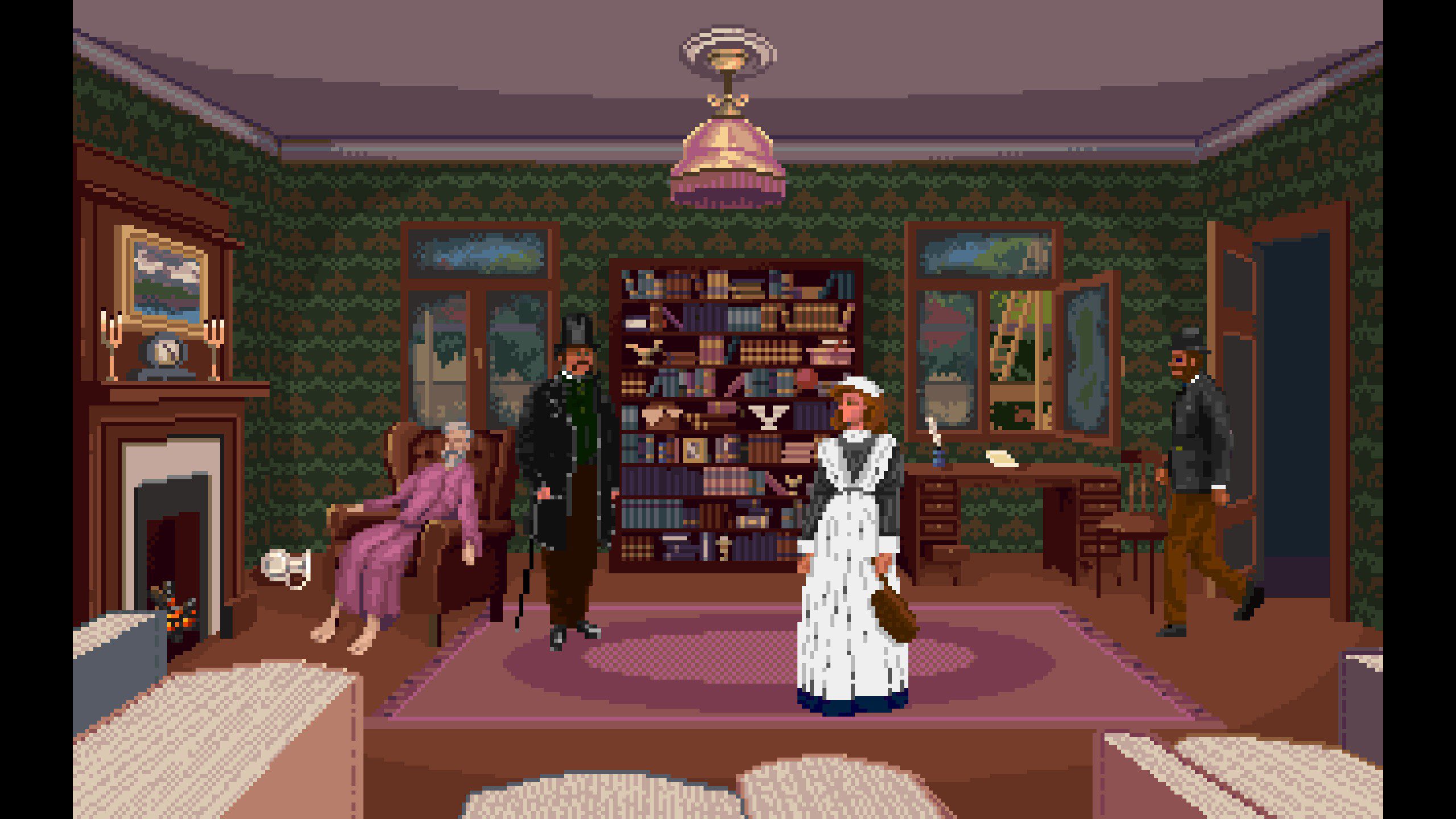
The game starts with the introduction of Hannah Faber, a retired teacher who is waiting for Joseph, her lodger, to return home for the day so that she can listen to his retelling of his latest solved case. The scene opens with a strange, empty, dark space effect with Joseph and Hannah merging in and out as blue ghosts as they exchange conversation, kicking off the first case, Madcap Motorist.
As Joseph, we’ll explore each scene for clues and usable items. Any clues that we pick up will be noted in his journal. We can then combine related clues to form further clues which we can question witnesses and suspects about, or deductions which will usually come with a decision to make regarding our understanding of the case. For example, if we’ve learnt something that may debunk a suspect’s alibi, then we’ll need to decide whether or not this means that the alibi is invalid. Once we have several decisions in place, Joseph can tie them together and form a solution, which we can either choose to go with and arrest whoever he has concluded is the killer, or continue the investigation and look for more evidence to see if we can draw up another option. In a point-and-click fashion, we’ll also have some environmental puzzles to solve using our inventory.
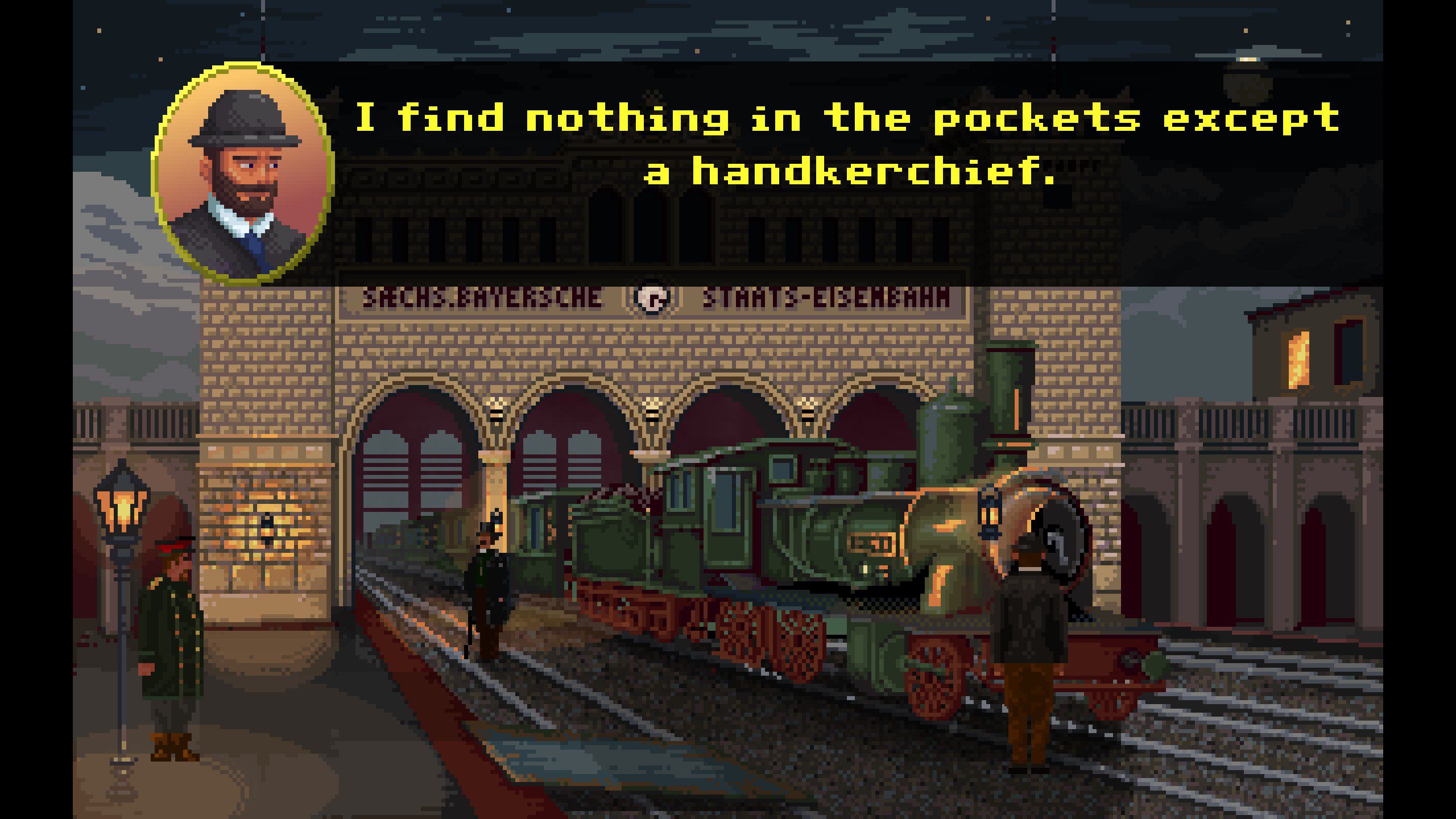
Accompanying us is Public Prosecutor Gustav Möbius, who acts as a hint system and will also highlight all of the points of interest in the area to avoid you having to go pixel hunting. While I relied on the hint system quite a bit due to the fact that Casebook 1899 can be very tricky, even for an avid point-and-click fan, I do think that a lot of the time it would be far too vague to be of any help anyway. Gustav would often point out the obvious without actually giving any pointers on how we might go about what we need to do. The only time I found him to be of help was when he would confirm that we’ve already covered everything in the area and can move on, which saved me a lot of time.
Each case is generally well-written and reminded me a lot of Agatha Christie’s stories in how there are multiple different avenues to each case, the solution not making itself fully clear until right at the very end. I also liked how it’s never immediately obvious what has happened; I was always left guessing and unveiling entirely different scenarios to the one I had pictured. Casebook 1899 does this by holding back just enough information from the crime scene to prevent the plot of that case from being immediately obvious before you’ve had a chance to talk to everyone and uncover further information. In some cases, even how the victim actually died was the last piece of information that I uncovered, having first worked out who had done it. Having four cases to uncover rather than focusing on a single plot also kept the story interesting, and prevented it from suffering from any pacing issues.
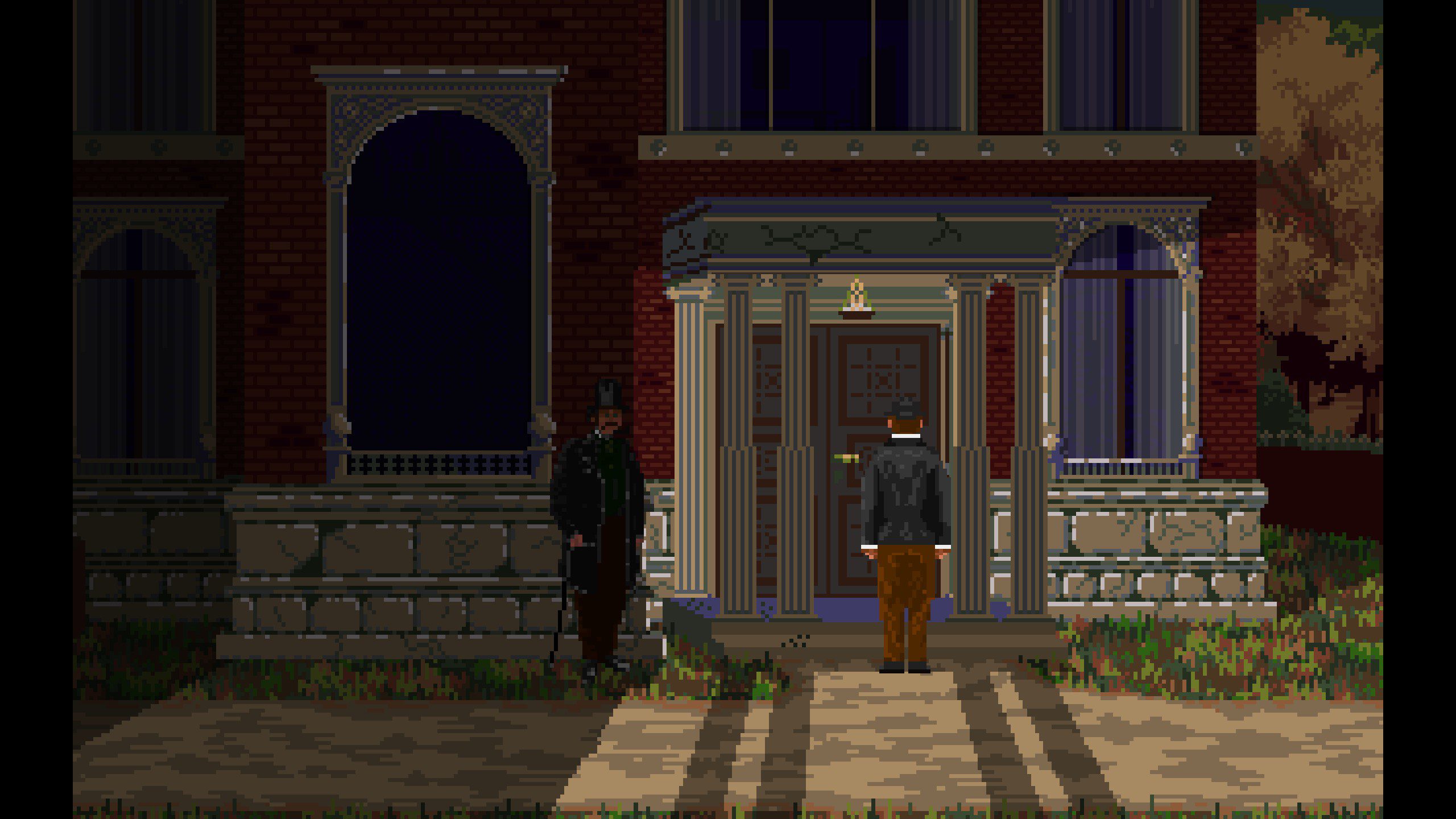
The setting of an industrial city reaching the 20th Century gives each environment a distinct look, which is beautifully mapped out by the game’s pixelated art style. Casebook 1899 is brimming with colour and detail, creating a gorgeous depiction of 19th-Century Germany. To go with it is a classic murder mystery soundtrack that you would expect from a game like this, staying mostly quiet during investigating and then rising for more story-intense moments. Casebook 1899 is fully voice-acted in German, which helped to add to the authenticity of the setting. While I can’t comment on the voice acting performance since I don’t speak German, I did really like the ASMR-style noises that Joseph would make while pondering over findings, it gave me the same vibes as Poirot twirling his mustache while deep in thought.
While it took me just over ten hours to complete Casebook 1899 – The Leipzig Murders, I did spend a lot of time stuck due to (now fixed) bugs. In reality, it will likely take around six to seven hours to complete, especially for those like myself who find themselves challenged by its array of tricky puzzles. While I didn’t feel like the puzzles were overly complex to the point that they were poorly designed, I do think a lot of the difficulty stems from a lack of direction in what the goal is for certain puzzles, and a hint system that doesn’t offer much. That being said, Casebook 1899 is an excellent point-and-click detective game which I recommend to fans of the genre, especially those who are looking for games that fully let you take the reins in the investigation.
Jess played Casebook 1899 – The Leipzig Murders on PC with a provided review copy.