
It’s October once again, and that means kids are counting down to the day of massive sugar highs and the rest of us are thinking about how much we want to scare the little devils. It’s also the time of year when horror-themed games get pushed by publishers and “spooky season” cosmetics pop up in various live service games. This year, we thought we might take a look at how horror and the supernatural are handled in the games space. The only rule: single titles only. Nothing that became a series, nothing that had a direct sequel or was itself a direct sequel. If you’re expecting to see mention of Resident Evil or Silent Hill, we’re not going there, because they’ve been sequelized so many times that they’re almost a caricature of horror movies (looking at you Jason and Freddie).
To kick things off, we thought we’d go back to a classic from the 16-bit era, Chakan: The Forever Man.
In The Beginning
In July 1990, independent comic book artist Robert A. Kraus put out Chakan: The Forever Man No. 1, based off a character he’d created for a side story in his earlier Thundermace comic. Kraus has described the character as looking like “a cross of a zombie and Clint Eastwood.” While attending GenCon one year, Kraus met up with Ed Annuziata, a producer at Sega of America best known for Ecco The Dolphin. Annuziata’s interest was piqued and he spoke with Kraus at length. From that conversation, a video game classic was born.
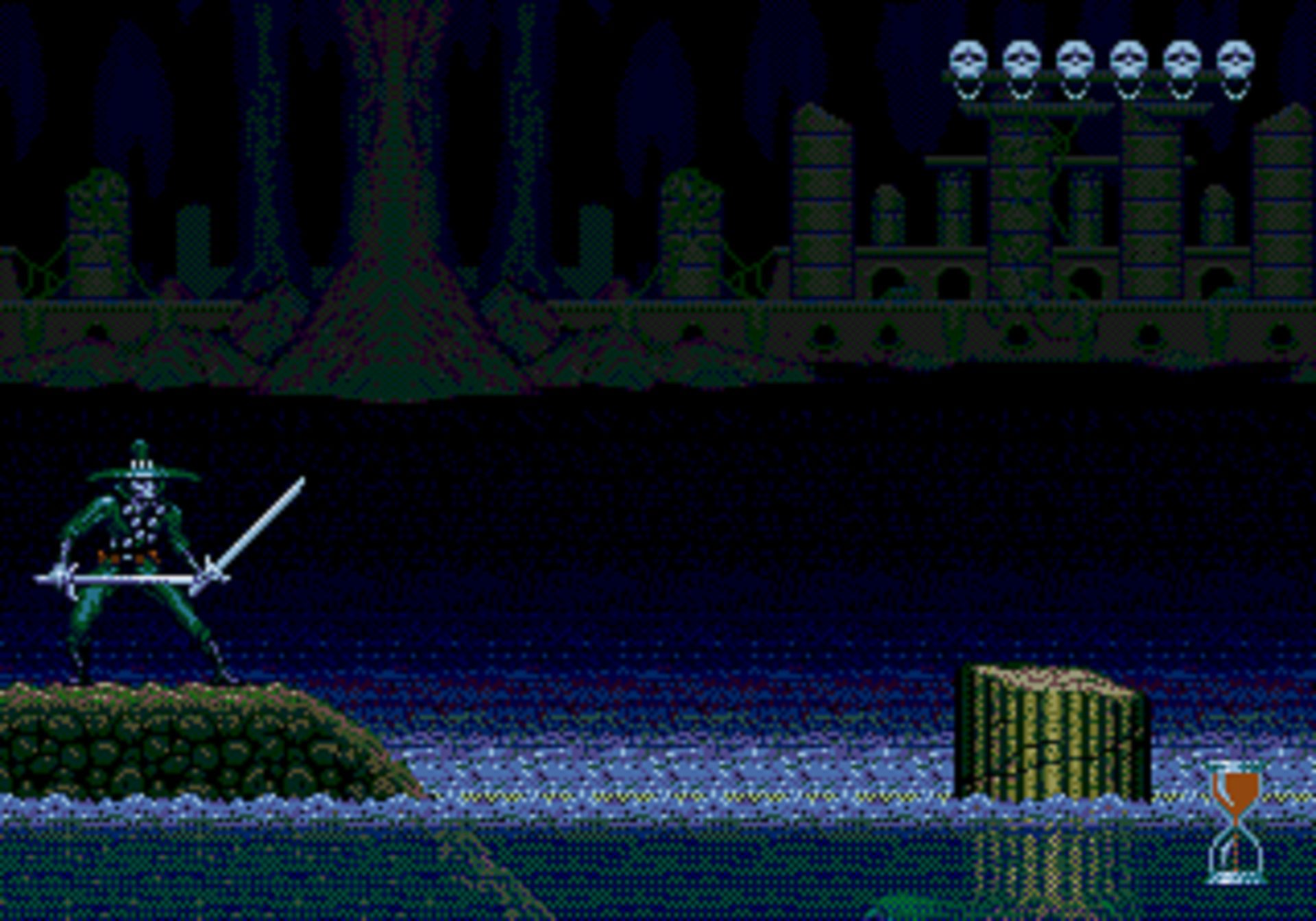
Chakan: The Forever Man released on the Sega Genesis (Mega Drive) in early June of 1992. In modern parlance, Chakan could be considered a metroidvania of sorts, a 2D action platformer with a central hub, lots of exploration, different weapons to obtain which help the player progress through the various environments, all that good stuff. It came out at a time when Sega (along with its immediate rival, Nintendo) were giving us Sonic and Mario for platforming games. Chakan made good use of the Genesis’ hardware, giving players a fast-paced challenge while tapping into a very horrific atmosphere.
The Duel, And After
Narratively, Chakan sticks close to the comics which had been released prior. We’re treated to an introductory sequence where Chakan tells us how he got to where he is. At one point, he was mortal, but also a serious badass. A past master of the blade, well versed in magic and alchemy, he rashly boasted that he could even defeat Death itself. Naturally, Death picks up the gauntlet Chakan has thrown down and the two of them face off in an epic duel. The stakes are simple. If Chakan wins, he gets to live forever. If not, Death claims his soul. The duel concludes with Chakan squeaking out the win. Unfortunately, Death’s either a sore loser or Chakan was being set up for the long drop. Chakan does in fact become immortal, while losing his good looks along with his magic and getting tormented with visions of all the terrible things demons and monsters do to ordinary folks. Having now clubbed Chakan with a monkey’s paw, Death offers him a way out. If Chakan can destroy all supernatural evil, Death will grant him the mercy of release from immortality.
At the start of the actual game, we find Chakan in his sanctuary, the hub zone where he travels to the realms of the last evil beings on Earth. When he first enters a realm, we’re given the high level overview of our intended target in suitably Byronic prose. The starting level of each realm also has a new weapon for Chakan to acquire as part of his quest, and each helps overcome certain obstacles found across all four realms. You have to clear three levels in each realm in order to defeat the boss. Clear all four bosses and… you’re in for round two. Having cleared the monsters of the “terrestrial realm,” you must then set your sights on four more boss monsters on the “elemental planes of evil” (possibly a nod to the classic Dungeons & Dragons adventure module “The Temple of Elemental Evil”).
The gameplay in Chakan was definitely a couple levels tougher than the typical Sonic The Hedgehog run. Complicating things was the fact you were on a countdown timer, and if you ran out of time, you had to start your run through a given plane all the way back at the first level. The alchemy component of the game added another layer of complexity, since it was not exactly well explained. For all the difficulty you found in the original Castlevania and Metroid, the challenge in Chakan was almost punishing. One wonders how much the guys at From Software were influenced by this title.
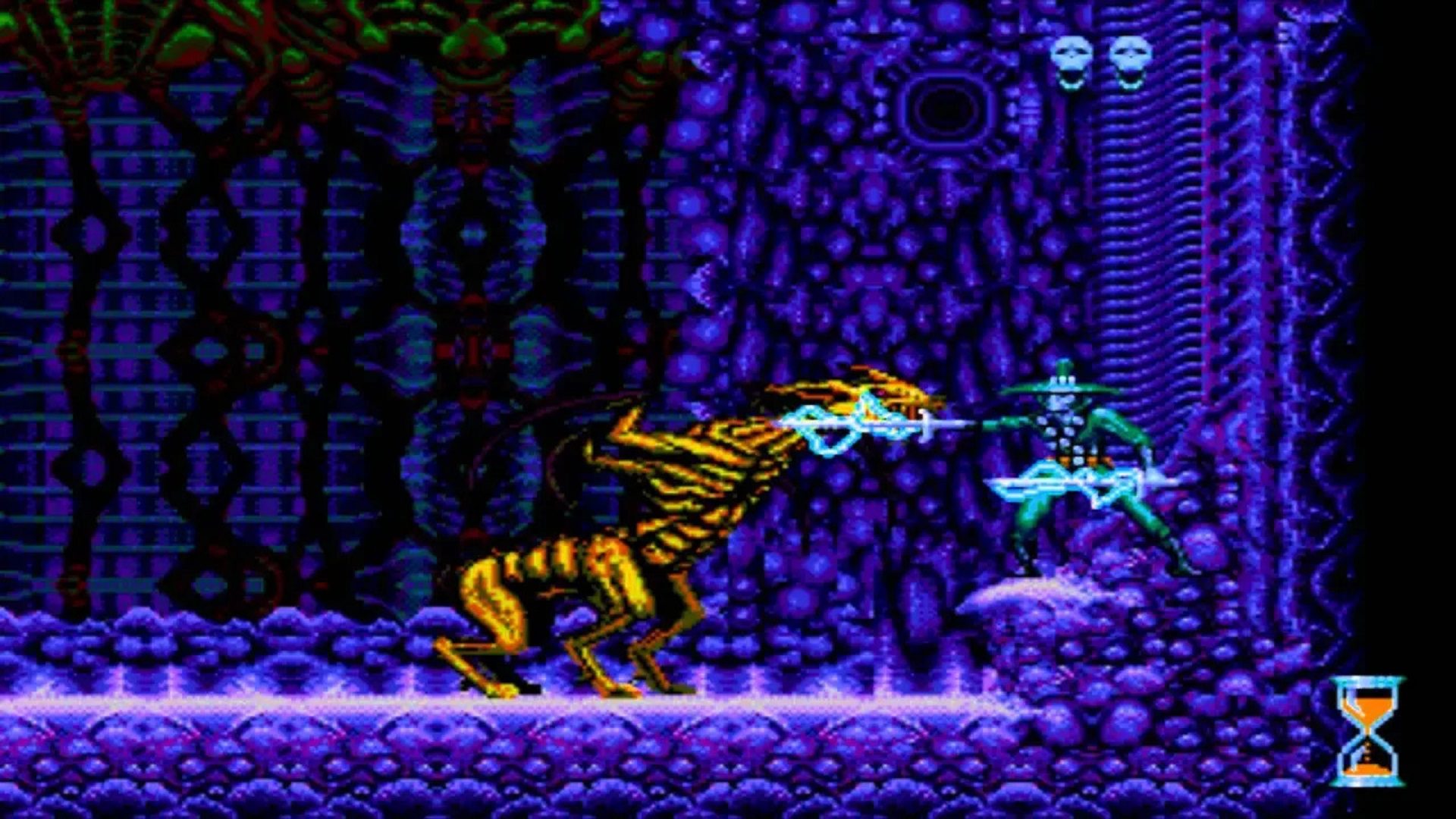
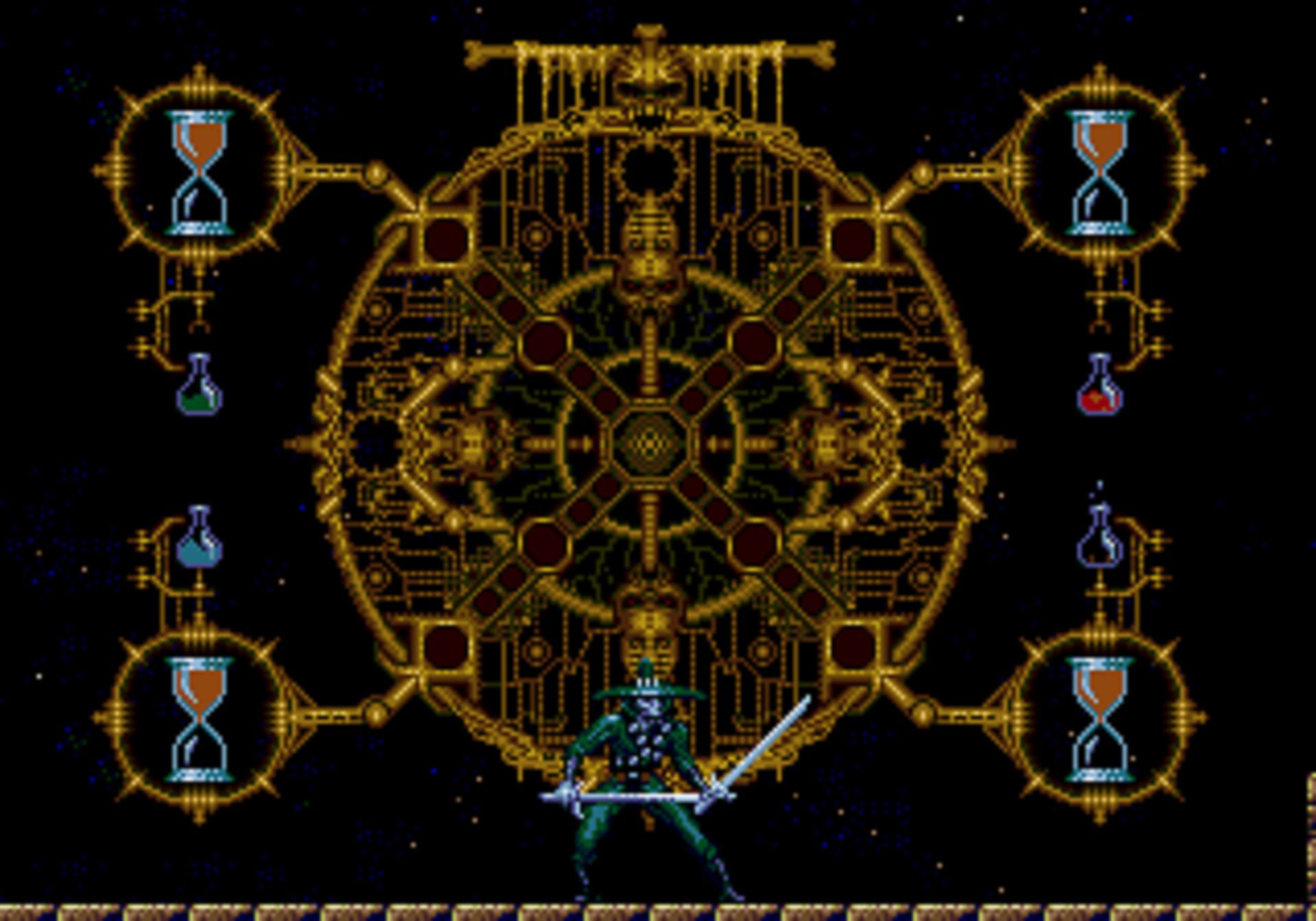
At the very end, having wiped out eight different bosses across a total of thirty-two different levels, Chakan stabs himself, certain that he’s earned his reward. And then Death comes around in possibly one of the most rage-inducing moments in gaming history. Chakan doesn’t die, and Death shows him the starry sky above. Each star has a world full of supernatural evil, and Chakan hasn’t even begun to touch those guys yet (nor will he for who knows how long; there’s no way to visit the stars by magic). Death offers up a foretaste of what Chakan can expect with a final boss fight: one shot, no do-overs. If you lose to this boss, Chakan basically shrugs it off with a fatalistic quip that “rest will come another day.” Actually beating this final boss leads to the background screen we’ve seen in the exposition sequences (displaying an ornate hourglass) sitting without anything for fifteen minutes before one line of text finally appears reading, “Not the end.”
Still Waiting
After its initial release, a port of Chakan: The Forever Man came out for the Sega Game Gear six months later. And then, nothing. No sequels came out during the Genesis era, nothing for Sega CD, same for the Saturn. Ed Annuziata was reportedly working on a sequel for the Dreamcast (and ostensibly other platforms) which would have had Chakan on one of those far flung worlds among the twinkling stars. But that was back in 2001. Since then, it’s been dead silence.
It’s an intriguing sort of “what if?” scenario to contemplate. Could an indie comic inspired, horror-themed, action-platformer have survived to the present day given more encouraging conditions? Would we be referring to derivative games as “chakametroidvanias” in deference to the bizarre trinity which might have been? Would Chakan appear as a guest fighter in Mortal Kombat or Injustice? Or possibly even the Monster Hunter series? So many possibilities come to mind.
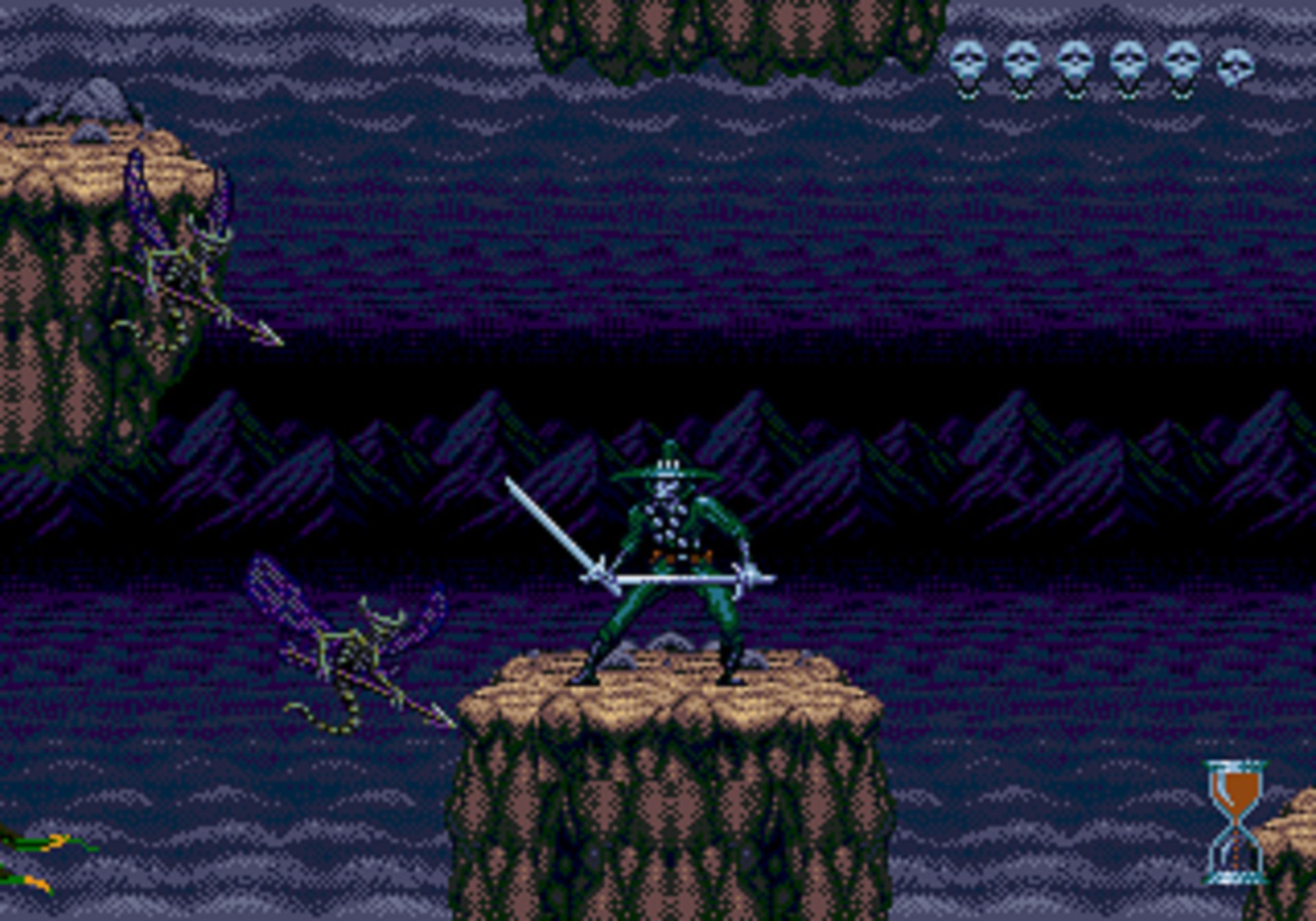
For right now, reprints of the early Chakan comics and graphic novellas, along with more recent works, are out there for purchase. The video game occasionally comes up on some collections of Sega titles, but remains generally unavailable. And it is absolutely a crying shame that more hasn’t been done both to preserve the original or develop new games based off the character. We can only hope that it really isn’t the end.