Lead: Nintendo’s third Ask the Developer interview for Fire Emblem: Fortune’s Weave examines how the team approached the game’s setting, music and characters ahead of its Thursday, September 17, 2026 launch. The interview, translated from the original Japanese and conducted before release, describes the title as a Nintendo Switch 2 exclusive. Director Toshiyuki Kusakihara, producer Masahiro Higuchi, producer Genki Yokota and associate producer Kenta Nakanishi discuss efforts to give the game a distinct atmosphere while retaining its connection to Fire Emblem: Three Houses.
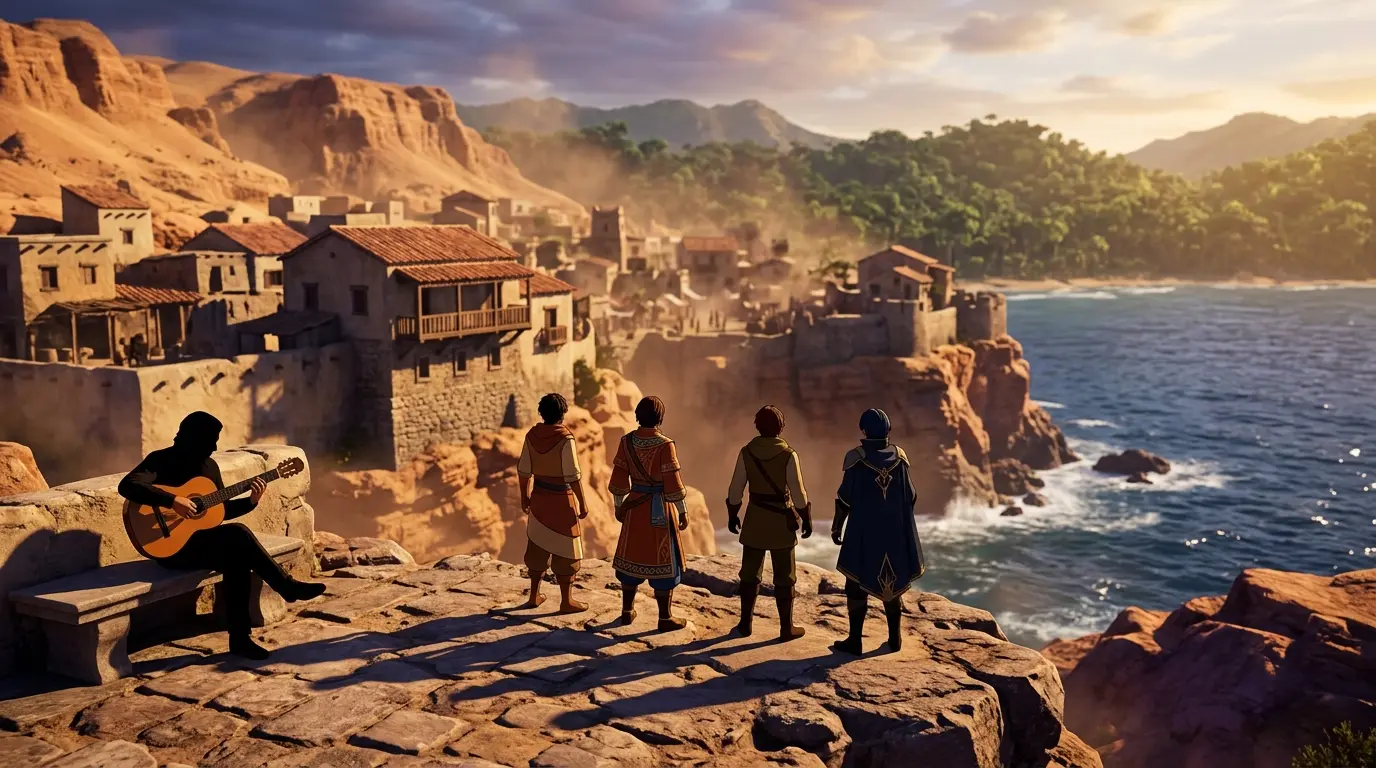
Fortune’s Weave shifts its setting from Fódlan to Dagda. The two continents are part of the same world, and Nintendo says that some characters from Three Houses also appear in the new game. Dagda is presented as a continent of many nations and factions, with a vast yet dangerous ocean, a desert with constant sandstorms and a vibrant rainforest. That setting informed a visual approach intended to feel different from the academy setting associated with Three Houses.
Character designer Chinatsu Kurahana, who also worked on Three Houses, returned for Fortune’s Weave. The developers say the character designs and outfits considered each region’s climate and environment, along with the backgrounds of individual characters in each faction. They point to contrasts among the groups: Cai and his clan represent ordinary villagers, Theodora’s clan wears ornate clothing tied to prosperity from foreign trade, Leda’s people draw on the image of travelers, and Dietrich’s Fódlan origins make his group stand out within Dagda.
Context Block: The contrast with Three Houses also extends to the music. Kusakihara said the team wanted the sound to evoke an ancient Mediterranean atmosphere, battle arenas, dry air, the blue sea and flames of passion. The game’s music incorporates flamenco-inspired elements, hand claps and percussion to express what the developers describe as the raw vitality and rugged energy of ancient peoples. Kanazaki continued as sound director from Three Houses after Kusakihara shared the musical vision and keywords including strange-ancient and wonder-ancient.
The main theme is also part of a broader musical structure. Kusakihara said each main protagonist has a thematic musical phrase, and those phrases are arranged together when the protagonists come together in the game. Higuchi said the resulting sound clearly differentiates itself from the world of Three Houses, while flamenco guitarists performed many of the guitar parts featured in Fortune’s Weave.
The interview frames the four protagonists around family while avoiding simple hero archetypes. Nakanishi said none of the four leads or the people around them can simply be described as righteous heroes, because they each carry their own struggles and perspectives. Kusakihara similarly described a view that people cannot be defined only through good and evil, with the game reflecting characters who may initially seem unlikable but become more understandable over time.
- Cai follows a young boy’s growth, with family at the center of his journey.
- Dietrich encounters others through the experience of a surrogate family.
- Theodora draws parallels between a nation and a household, and between a king and the head of a family.
- Leda pursues revenge after others take her home and family.
The developers say supporting characters also confront family in distinct ways. Their stated aim is to portray the different ways people in Dagda choose to live, including the struggles and hardships that accompany life.
The interview also provides a clearer outline of the game’s structure than a setting-and-character discussion alone. Players can explore Dagsion and the world map, recruit allies, develop characters and explore dungeons. Each protagonist has gameplay designed around that character’s traits: Cai can catch and care for animals and work fields, Dietrich can acquire and strengthen combat arts, Theodora can recruit and deploy soldiers as battalions, and Leda can perform in taverns for rewards or information.
According to Nintendo, players can begin with any protagonist and move between their stories as they progress. Locations unlocked on the world map in one path can later be available in others. The interview also says the class system from Three Houses returns, allowing characters to pursue different classes when they meet the relevant skill requirements. Fortune’s Weave supports mouse controls through the Joy-Con 2 controllers.
Editorial Verdict: Nintendo’s interview presents Fortune’s Weave as a deliberate departure from the academy atmosphere of Three Houses rather than a break from its world. Dagda’s climate and environments, region-conscious character designs, flamenco-inspired music and family-focused protagonists all serve that stated distinction. The developers’ emphasis on characters with competing perspectives gives the new setting a thematic focus alongside its visual and musical changes.
Nintendo has confirmed the September 17 launch date for the Nintendo Switch 2 exclusive. The pre-release interview lays out the team’s intentions for Dagda, its cast and its gameplay systems; how those elements work together will be established by the finished game.