
When coverage for the original PlayStation 5 began trickling through the interwebs back during the lockdown era of 2020, I remember excitedly clicking every video and article, reading and consuming anything and everything about Sony’s brand new console—whatever to keep my mind distracted and my health anxiety at bay. However, this giddiness was soon replaced with a quizzical furrowed brow when I learned that players had to choose between a “Quality” or “Performance” mode when playing the newest releases on their newly purchased $500 console. It was odd, because even though outlets like Digital Foundry praised the power of the machine, mentioning how unlike the previous generation the PS5 (and Xbox Series X) were relatively on par with the processing technologies of its PC counterpart for the time, players still couldn’t play cross-generation titles like Horizon: Forbidden West in native 4K at 60fps. For a console that is reportedly nearly nine times more powerful than the PS4, one that touted the now removed “8K” sticker on its retail box, I would think a feat such as that would be a no-brainer. Alas, such was not the case and players have had to make the Sophie’s Choice between the two modes for the past four years. That is, until now.
On September 10th, 2024, lead architect Mark Cerny hosted a live stream revealing the PlayStation 5 Pro. A console that is supposedly going to be a significant power bump over the base PS5 and will allow players to play games at that much coveted 4K resolution at 60 frames per second; doing so using a combination of the console’s increase in graphical power and Sony’s new A.I. upscaling technology. Though Cerny made it a point to say that the image quality wouldn’t be a 1:1 comparison to the existing “Quality” mode of the PS5, it’s still great to finally be able to combine the two modes for one “Enhanced” mode that gives players the best of both worlds. It’s exactly the thing that I personally have been waiting for before jumping into this new PlayStation generation. That is, until the price was revealed at the end of the stream. The PlayStation 5 Pro will be putting a sizeable $700 ($950 for Canadians such as myself) dent in your wallet. When reading that Sony is pulling an Apple and will not be including either a disc drive or a stand for that price, I began to question whether spending over a band on a console that, though does the thing that I wanted four years ago, is still a mid-cycle refresh with the same CPU is actually worth it. Especially when considering that I’ve been tinkering with an alternate solution that’s given me all that the PS5 Pro can do, for a fraction of the cost.
A Journey to the Cloud
When Baldur’s Gate 3 was released to universal acclaim last year I, as a sad Xbox Series S owner, began to finally consider biting the bullet and buying a PS5 in order to play this game that everyone was calling a masterpiece. However, right before placing my order for Sony’s console, the algorithm gods showed me an advertisement for a service called Geforce NOW. The ad showcased Larian’s game running via the cloud on Nvidia’s service pretty flawlessly and with all the bells and whistles turned on. As someone who’d only tried Xbox Cloud Gaming up until then to varying success, I was skeptical. But my frugal mind decided the risk had the potential for tremendous savings. And so, I bought Baldur’s Gate 3 on Steam – even though I didn’t (and still don’t) own a gaming PC – and booted up Nvidia’s service on my Logitech G Cloud. On the free tier, I had to wait a few minutes before I got connected to the server, but once connected, it wasn’t long before I was off walking across the beaches of The Forgotten Realms.

I was in awe, frankly, at seeing just how smooth everything played and how good the visuals looked. Up until then, I was used to the low bit-rate image, audio desyncs, latency issues, and overall jankiness that was Xbox Cloud Gaming. Geforce NOW felt different. After my first hour of play, I’d forgotten that I was playing via the cloud. It was enough proof for me to pay Nvidia the fourteen bucks a month to get on their “Priority” tier, which allowed for less waiting times, longer play sessions, and a beefier graphics card. Over the next few months, I would go on to play through the entirety of BG3, Cyberpunk 2077 Ultimate Edition, and Alan Wake 2; playing them all on ultra settings with as much ray-tracing as I could get without dipping below the 60fps mark. It was incredible, honestly. I was getting far better visuals and much higher framerates than I would have on my Series S and even on a PS5 if I were to have gotten one. Doing so while having the flexibility to play either on my 4K T.V via an HDMI cable, or anywhere with a decent internet connection–playing Cyberpunk on RT Overdrive in a hotel room while on vacation on my G Cloud was a trip and a half, I’ll tell ya.
The PS5 I’ve Always Wanted
Yet, I was still missing something: Sony exclusives. For as good as GeForce NOW is, Nvidia’s continuing hurdle has been its library of games. You see, you can’t just play any of your purchased PC games via GFN. Nvidia needs to get permission from publishers, who then need to “opt-in” for their games to be available on the service. With Sony slowly getting their own cloud infrastructure in place, and with how they treat their exclusives in general, it’s a safe bet that we won’t be seeing Kratos and Aloy on Nvidia’s service any time soon–or ever. However, there’s a small company over in Ukraine who are not afraid to exploit some legal loopholes to get Sony’s (and many other big publishers) games on their cloud platform.
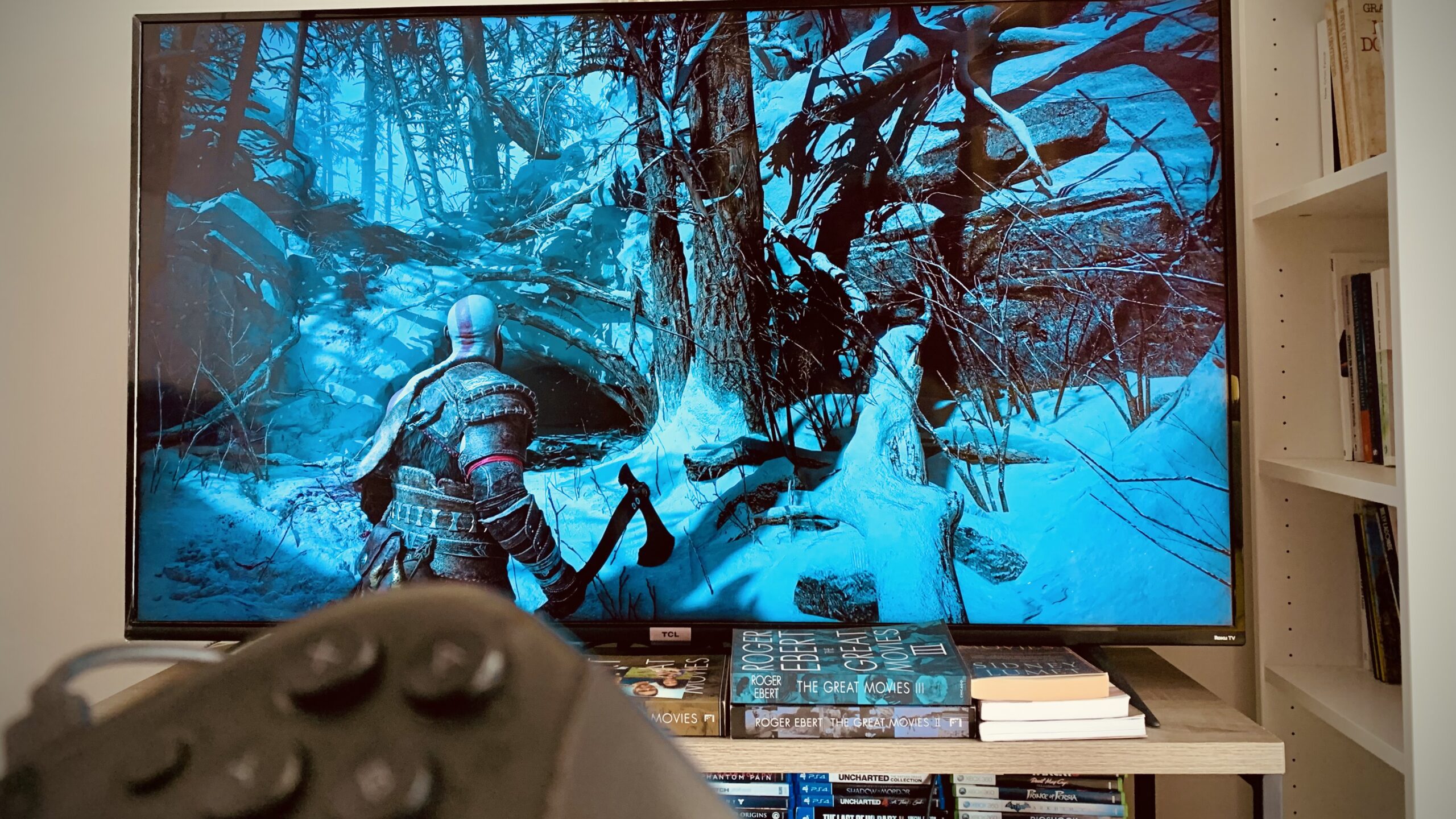
Boosteroid offers essentially the same service as GFN, though with a far larger catalogue of accessible games and a more straightforward (and slightly cheaper) monthly fee when compared to Nvidia’s “Ultimate” tier. The service isn’t as refined as Nvidia’s, with some quirks that you’ll have to overcome. It’s also limited in terms of controller and platform support; I wasn’t able to play on my G Cloud, for instance. Slight annoyances aside, I have now completed Horizon: Forbidden West and am currently ten hours into God of War Ragnorok–all through Boosteroid. It’s been a fairly seamless experience, to the chagrin of Sony, I’m sure. Playing both games at 4K, ultra settings while retaining a consistent 60fps has been a joy. It’s to the point where I can’t imagine even considering a PlayStation 5 Pro at this point because, for the price of that console, I could get three years’ worth of a subscription to either Boosteroid or Geforce NOW. If Xbox Cloud Gaming showed me the potential of what this technology could be capable of, then both of these companies have nearly realized that potential and have brought me to a future where console gaming have become obsolete.
Caveats & Concerns
Alright, I’ve waxed positive on cloud gaming for four paragraphs, so let’s rein things in a bit. Firstly, understand that the biggest reason I’ve had such a great experience with this technology is because I’m in an ideal situation. I’m located in a city where both Nvidia’s and Boosteroid’s servers are ostensibly next door, I have gigabit internet with no data caps running through one of the latest routers, and play all of my games via a wired controller (the G Cloud is also “wired,” technically). As such, latency, audiovisual hiccups caused by packet losses, or any other common issues surrounding these services aren’t nearly as frequent for me as they are for many others. That being said, understand that even with this set-up, I still run into minor annoyances. I’m sure if I ran a frame-time graph it would be anything but a flatline as micro stutters are quite common for me, especially when running via an HDMI cable to my TV (although that could be a decoder issue by my laptop). Nevertheless, I’m willing to put up with these minor annoyances because the overall experience has been fantastic and the cost-savings speak for themselves.
Furthermore, some space for concern should be kept for any streaming services such as these as it pertains to access to media. Although both require you to purchase your games, so ownership of media isn’t as much of an issue as it is with film and television streaming networks, both GFN and Boosteroid can easily remove any game from their catalogue at a moment’s notice. If you’re like me and don’t have a PC capable of running many of the games in your Steam or EGS libraries, then you’re unfortunately out of luck. This is doubly an issue for Boosteroid, whose main allure is their Sony exclusives. Their tactful exploitation of murky legal loopholes has worked thus far, but who’s to say that Sony doesn’t send over their suits to pull their games off the service tomorrow; leaving someone like me unable to access my purchased games?
It’s still early goings for cloud gaming, but it’s been quite amazing to see how far the technology has come. A technology that’s still far from perfect with some bigger concerns about game libraries and player access needing to be addressed, but one that I’ve used over the past year to play through some of the most incredible titles, leading to it now effectively having replaced my Series S as well as my desire for a PS5 Pro.